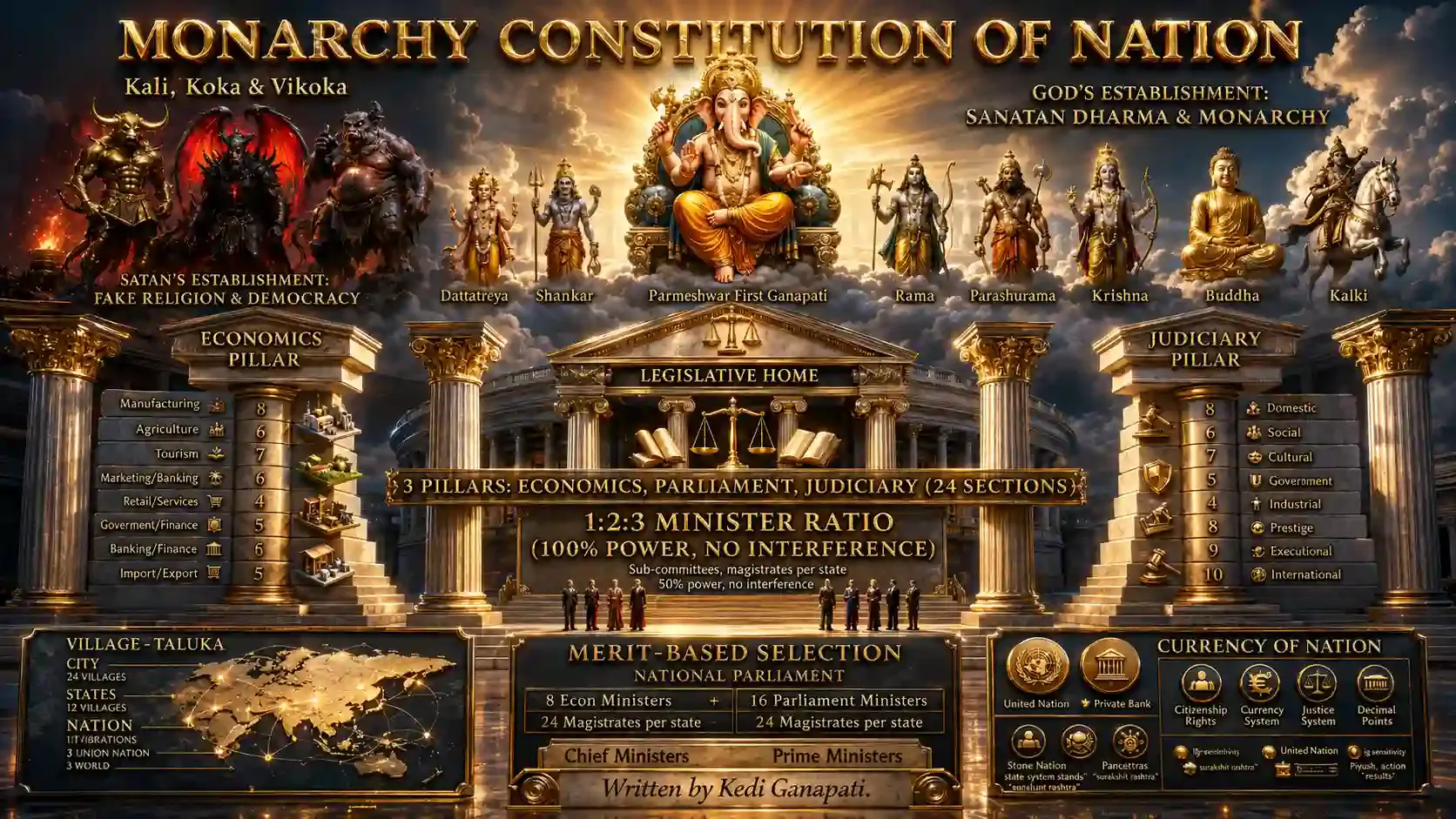
Origin of the Constitution
Parmeshwar First Ganapati created a monarchical constitution for nation-building.
Incarnations of Bhagwan Shankar, Dattatreya, Parashurama, Ram, Krishna, Buddha, and Kalki established Sanatan Dharma and the constitution.
In Sanatan philosophy, there exists a concept of opposing forces — one that upholds Dharmic order, and another that promotes materialism and division.
Types of Constitutions
2.1 Monarchy vs Democracy
| Feature | Monarchy | Democracy |
|---|---|---|
| Power Distribution | 100% ruling ministers | 75% ruling, 25% opposition |
| Opposition Rights | None | Can interfere in legislature and executive |
| National Planning | Smooth, uninterrupted | Disrupted by opposition, risk of treason |
| Citizen Unity | Promotes patriotism | Can foster inequality, casteism |
| Ministerial Accountability | Immediate punishment for treason/corruption | Often unpunished |
| National Objective | Nation-first | Personal or party gain, corruption |
Pillars of the Monarchy Constitution
Three Pillars: Economics, Parliament, Judiciary.
Three Homes:
- Legislature — Parliament
- Executive — Government firms
- Judiciary — Courts
The constitution comprises 24 Sections — 8 each in Economics, Parliament, and Judiciary.
Ministerial Ratios
- Economics: 1:1
- Parliament: 1:2 — Minister and Deputy
- Judiciary: 1:3 — Hear, Examine, Judge
Separation of Roles
Ministers and magistrates work only in the legislature.
Executive officers work in the executive home.
Executive magistrates work in the judiciary.
3.1 Economics Sections
- Manufacturing
- Agriculture-Husbandry
- Entertainment-Tourism
- Marketing-Broking
- Retail Services
- Government Firms
- Banking-Finance
- Import-Export
Ministers: 8
In addition:
- Chief Minister of Economy per state
- Prime Minister of Economy for the nation
3.2 Parliament Sections
- Education
- Development
- Property
- Defence
- Foreign
- Health
- Revenue
- Culture
Ministers: 8 Deputy Ministers: 8
In addition:
- Chief Minister of Parliament per state
- Prime Minister of Parliament for the nation
3.3 Judiciary Sections
- Domestic
- Social
- Cultural
- Government
- Industrial
- Prestige
- Executional
- International
Magistrates:
- 8 for hearing
- 8 for examining
- 8 for judgment
In addition:
- Chief Justice per state
- Prime Justice for the nation
Fundamentals of the Monarchy Constitution
- Single king, religious and educated, elected based on intelligence and contributions.
- King serves for life; ministers may change but the king remains.
- Citizens are divided into Original Citizenship and Refugee Citizenship.
- Original citizens hold equal rights; refugee citizens’ rights are graded.
- One identity card for all communities.
- No caste-based privileges.
- National governance may draw inspiration from India’s ancient civilizational wisdom while respecting the diversity of all communities.
Partition of the Nation
Area and population determine division.
The hierarchy flows as:
Village → Taluka → City → Metropolis → District → State → Nation → United Nation → Union Nation → World Nation
24 units combine to form higher levels — 24 villages form 1 taluka, and so on through the hierarchy.
Parliament of the Nation
There are four levels of parliament:
- Nation Parliament
- United Nation Parliament
- Union Nation Parliament
- World Nation Parliament
State Parliament
- 8 Economic Ministers
- 16 Parliament Ministers
- 24 Magistrates
Speaker: Chief Ministers of Economy, Parliament, and Judiciary — 3
National Parliament
- 3 Chief Ministers per state
Speaker: Prime Ministers of Economy, Parliament, and Judiciary + Prime Advisor + King — 5 prime humans
Currency of the Nation
There are four types of currency:
- Nation
- United Nation
- Union Nation
- World Nation
Currency must be eternal — bearing the image of Parmeshwar Ganapati.
One currency and one bank per nation; no private banks.
Currency is renewed every 18 years.
International trade rules govern United, Union, and World Nations.
Framework of the Constitution
Eight fundamental elements govern the constitutional framework.
Articles failing these elements must be amended or the constitution recreated.
- Citizenship and Rights
- Facilities and Reservations
- Currency and Property
- Religion and Culture
- Education System
- Justice System
- Electoral Process
- Economic Policy
8.1 Citizenship and Rights
There are two types:
- Original Citizenship
- Refugee Citizenship
Original citizens hold full rights in parliament, judiciary, and executive.
Refugee citizens’ rights are based on purpose; they may gain full citizenship upon fulfilling their duties.
8.2 Facilities and Reservations
Emergency aid is given based on need, not caste or religion.
Economic, intellectual, and physical reservations are granted individually, not on a caste basis.
8.3 Currency and Property
One currency and one property department.
Currency is renewed within 18 years.
Land and natural resources are national assets — no private ownership.
8.4 Religion and Culture
The government upholds the values of Dharma — truth, justice, and compassion — which are universal in nature.
8.5 Education System
Indigenous scientists and scholars are included in the curriculum.
Three pillars:
- Cultural schools
- Economic institutions
- Research universities
Education is free, with economic support and encouragement for invention.
8.6 Justice System
Eight courts:
- Domestic
- Social
- Cultural
- Government
- Industrial
- Prestige
- Executional
- International
Court decisions are final within each court.
National laws are decided in Parliament House.
8.7 Electoral Process
Jobs in parliament, executive, and judiciary are based on competence.
Selection is determined by:
- Intellect
- Physical strength, where needed
- Mental stability
Voluntary service without salary is permitted as an exception.
8.8 Economic Policy
Balanced production and pricing of goods and services.
Categories of national industries and public-private sectors.
Tariff control and commodity markets.
International trade is based on fair currency or barter in cases of overvaluation.
Closing Words
This Gudi Padwa 2026, I am embarking on the creation of India’s new Constitution.
Writing this Constitution may take me around 5 years, and bringing it to life across India could take 10–20 years.
Note: This content represents a summary of Chapter 31 from The Spine of Sanatan Dharma, a 33-chapter work authored by Kedi Ganapati.