What Does Pitru Dosha Mean?
The word “Pitru” refers to the father, and “Dosha” means a flaw, weakness, or deficiency. In essence, Pitru Dosha refers to a deficiency in what a person is meant to receive from their father — whether that is name, wealth, love, art, culture, or inheritance.
When Pitru Dosha exists in a person’s horoscope, it tends to create obstacles in receiving these things from the father, or these things may remain permanently out of reach.
The Planets Behind Pitru Dosha
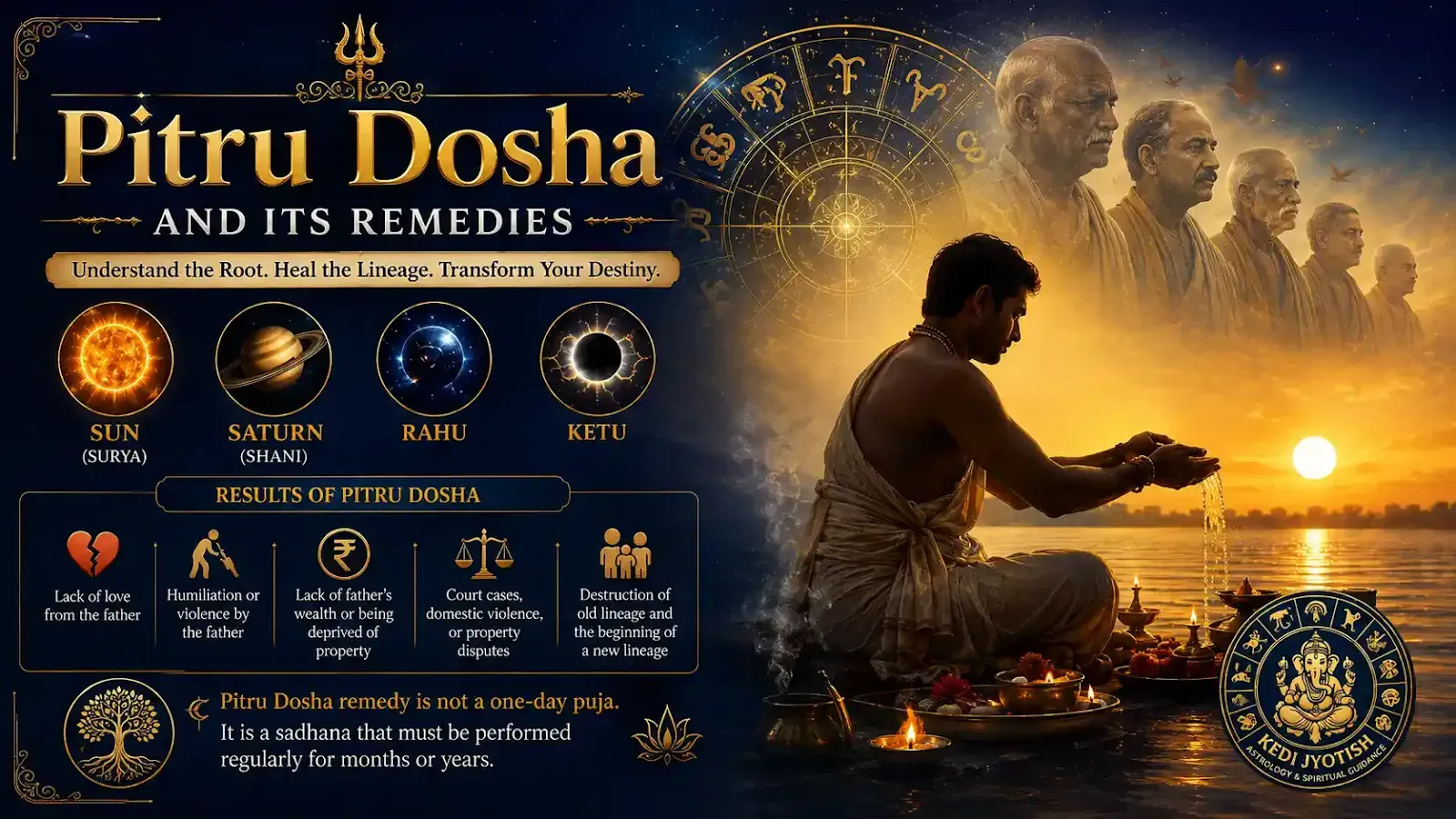
Four planetary forces are considered responsible for Pitru Dosha: Sun (Surya), Saturn (Shani), Rahu, and Ketu.
The Sun is regarded as the significator of the father. According to this tradition, when the Sun forms a relationship with Saturn, Rahu, or Ketu in a horoscope, Pitru Dosha comes into effect. If the Sun shares no such relationship with these three planets, Pitru Dosha does not form.
Is Pitru Dosha a Blessing or a Curse?
Interestingly, Pitru Dosha isn’t seen as universally negative. For a person who is strong-willed and courageous, it can act as a hidden blessing, pushing them toward independence and resilience. For someone who is passive or lacks drive, however, it tends to manifest as a genuine hardship.
In this view, Pitru Dosha marks the decline of one family lineage and the rise of another. A weak old lineage often gives way to a stronger new one, while a strong old lineage may see the new generation start off weaker.
Effects Associated with Pitru Dosha
Traditionally, Pitru Dosha is linked to outcomes such as reduced affection or connection with the father, conflict, humiliation, or even physical friction with the father, and being deprived of paternal wealth or property.
Other effects include legal disputes or serious conflict over ancestral property, as well as the decline of the paternal lineage and the emergence of a new one.
Pitru Dosha and Pitar Dosha: The Difference
Pitru Dosha and Pitar Dosha are different concepts and should not be confused with each other. The word “Pitru” refers to the father, whereas “Pitar” refers to deceased ancestors or relatives.
When the dosha is specifically related to the father and the things associated with the father, it is considered Pitru Dosha. Its remedy should therefore involve the appropriate Pitru Dosha-related karmakand and sadhana. Pitar Dosha is different; when the dosha is associated with deceased relatives or ancestors, the appropriate remedy may involve Tripindi Shraddha.
Therefore, Tripindi Shraddha should not automatically be prescribed for every case of Pitru Dosha, unless the Pitar Dosha is specifically connected with the deceased father.
Understanding the Remedy for Pitru Dosha
There’s no single, universal remedy for Pitru Dosha — the right approach depends on a person’s nature, tendencies, and personality. Responsibility for Pitru Dosha isn’t placed on the father alone; the son plays a role too. If the Sun is weak, the father’s influence is considered the contributing factor. If Saturn is weak, the son’s influence is considered the contributing factor. If both are strong, Rahu or Ketu is seen as the underlying cause.
A proper remedy requires understanding three things: the planetary positions in the horoscope, the individual’s nature and tendencies, and the actual goal behind seeking the remedy. Only once these three factors are studied together can an appropriate path forward be identified.
It’s worth noting that a genuine remedy for Pitru Dosha isn’t a single ritual performed once. It’s an ongoing practice — a sadhana — that typically needs to be sustained over months or years for it to have any real effect. A one-time puja offering quick reassurance is, at best, a placebo.
Note: This article explores Pitru Dosha through the lens of traditional Vedic astrology. The interpretations shared here reflect Kedi Ganapati’s own understanding of these concepts.