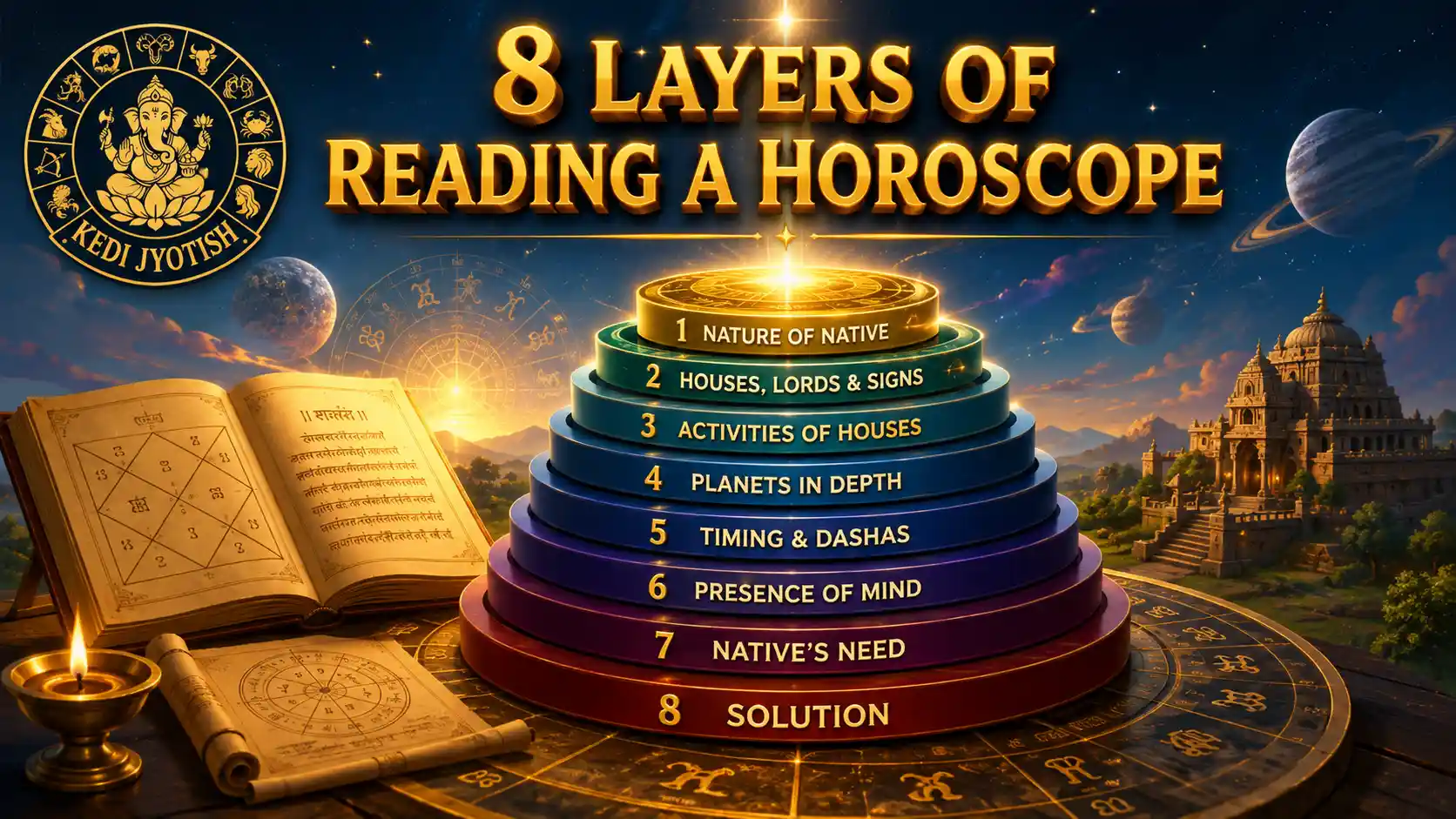
Layer 1: The Ascendant Lord and the Native’s Nature
The first step is to examine the Ascendant (Lagna) Lord, its house placement, and its Nakshatra. This provides an important foundation for understanding the native’s basic nature, temperament, personality, and behavioral tendencies.
Without first understanding the person, it can be difficult to interpret planets and houses correctly. The same planet or house may produce different results depending on the native’s overall nature and circumstances.
Before asking what the horoscope will produce, first understand the person through whom the horoscope will operate.
An astrologer should have a strong understanding of planetary and Nakshatra characteristics. Where necessary, reference books or notes may be used during analysis.
Layer 2: Houses, House Lords, and Signs
The second layer is to examine the twelve houses, their lords, and the signs occupying those houses. The house represents an area of life, the house lord indicates its governing planetary influence, and the sign provides the environment in which that house operates.
Consider a simple analogy: a house may be large and beautiful, but its condition depends greatly on its owner. A responsible owner may transform it into a comfortable home, while a careless owner may allow it to deteriorate. Similarly, the house lord can strengthen or weaken the matters represented by a house. The surrounding environment also matters — a beautiful house located in a desert may face difficulties, while even a modest house surrounded by a pleasant environment may provide comfort.
In short: House = the area of life, House Lord = the owner, Sign = the environment. The astrologer should examine the house, its lord, and its sign together rather than relying on any one factor in isolation.
Layer 3: The Activities of Each House
Every house represents multiple activities and areas of life. These are shaped by the planet occupying the house, the house lord, the sign occupying the house, planets aspecting it, the Nakshatra involved, connections between planets and houses, and the overall strength of these factors.
| House | Major Activities |
|---|---|
| 1st House | Self, body, personality |
| 2nd House | Wealth, speech, family |
| 3rd House | Courage, communication, effort |
| 4th House | Home, mother, inner comfort |
| 5th House | Intelligence, creativity, children |
| 6th House | Service, competition, obstacles |
| 7th House | Marriage, partnership |
| 8th House | Transformation, secrets, longevity |
| 9th House | Dharma, fortune, higher knowledge |
| 10th House | Career, action, status |
| 11th House | Gains, networks, fulfillment |
| 12th House | Expenditure, isolation, liberation |
A favorable yoga or dasha does not automatically guarantee success in every activity. The house responsible for that activity must also be examined.
The astrologer’s task is therefore not simply to identify a house, but to determine how the activities represented by that house are likely to function.
Layer 4: External Influences of Planets
A house does not operate in isolation. Other planets can influence a house through aspects, conjunctions, and other planetary relationships. These influences may strengthen, disturb, modify, or intensify the activities represented by the house — much like a family living inside a house is also affected by people outside it. A good relationship may bring support and opportunity, while a difficult one may bring conflict or loss.
The astrologer should examine which planets aspect the house, the nature of those planets, which houses they represent, what relationships exist between those planets and the house, and whether relevant conjunctions are supportive or challenging.
When two or more planets occupy the same space, they can influence one another and modify the expression of the houses they represent. A supportive combination may create cooperation between areas of life, while a difficult one may create complications. Conjunctions should never be interpreted mechanically — their planetary nature, house ownership, placement, and broader context must all be considered.
Layer 5: Timing — When a House Becomes Active
The twelve houses do not necessarily become equally prominent at the same time. A person does not simultaneously experience education, marriage, career, finances, family responsibilities, illness, and spiritual withdrawal with equal intensity — different activities become prominent during different periods of life. This is where Dasha analysis becomes important.
The astrologer should examine which planetary dasha is currently operating, which houses the dasha planet represents, where it is placed, which planets and houses are connected with it, and which activities are likely to become prominent during that period.
A native may strongly desire a particular activity, but the relevant house may not yet be sufficiently activated. When its appropriate period arrives, circumstances may begin moving more naturally toward that activity.
The horoscope indicates possibilities; timing helps determine when those possibilities become active.
Layer 6: Presence of Mind and Context
Astrological interpretation requires not only technical knowledge but also presence of mind. A horoscope must always be interpreted in the context of the native’s actual life. A strong seventh house and favorable marriage indicators, for example, do not mean that a six-year-old child is about to get married — the same indication must be understood according to the person’s age and stage of life.
Relevant context may include age, current stage of life, lifestyle, profession, family circumstances, environment, mental outlook, and immediate situation. People also change their goals over time, so an astrologer should not assume that an externally visible ambition necessarily represents the native’s actual direction.
There is an important distinction here. The wrong approach is to judge the person first and then force the horoscope to fit that judgment. The better approach is to read the horoscope first, then understand the person through the horoscope and their actual circumstances. If the native provides little information, the astrologer should avoid unnecessary arguments and make reasonable observations from the chart itself.
Presence of mind should be used after reading the horoscope — not as a substitute for reading it.
Layer 7: Understanding the Native’s Need
Every person who approaches an astrologer generally has a reason — career, marriage, relationships, finance, education, family, health, spirituality, or an important life decision. Understanding this actual need is essential.
A horoscope may contain hundreds of possible indications, while the native may currently need guidance about only one or two matters. If someone approaches an astrologer for career guidance but the entire consultation focuses on marriage, the astrologer may have provided technically correct information while still failing to address the native’s actual requirement.
This does not mean other aspects should never be discussed — a comprehensive reading for a friend or family member may naturally cover many areas. But in a focused consultation, the priority should be what is genuinely relevant.
Everything visible in a horoscope does not need to be told to the native. What is necessary should be communicated at the right time and in the right context.
Layer 8: The Final Solution
After analyzing the horoscope and understanding the native’s actual need, the final question is: what should the native do? This is where astrological understanding must become practical guidance.
Rituals or Karmakanda should not automatically be treated as the universal solution to every problem. Not every native is interested in rituals, and not every difficulty requires a ritual remedy. Solutions may be practical (actions, planning, habits, skills, career strategy, decision-making), psychological (mindset, confidence, communication, emotional responses, behavioral patterns), or spiritual (prayer, meditation, traditional spiritual practices, rituals, other forms of discipline).
The appropriate solution should be compatible with the native. A person who responds well to practical action may benefit more from practical guidance; someone struggling primarily with mindset may require psychological guidance; a person genuinely inclined toward spiritual practices may find traditional approaches more appropriate. An astrological remedy does not necessarily change the horoscope itself — rather, it may help the native respond more appropriately to the circumstances the horoscope indicates.
One problem does not necessarily have one universal solution.
The astrologer should avoid prescribing the same remedy to every native simply because it worked in another case. The purpose of astrology is not to force every person into the same remedial framework — it is to understand the individual and identify an appropriate path for that individual.
Conclusion: The Sequence of the Eight Layers
The sequence of these eight layers is not fixed. Every astrologer develops expertise in particular areas of astrology, so there is no requirement to examine the house, planet, Nakshatra, sign, conjunction, aspect, or dasha in one predetermined order. An astrologer may begin with any of the first seven layers and move between them freely — beginning with Layer 1, moving to Layer 5, returning to Layer 2, and then proceeding to Layer 6, for instance.
Layer 8, however, is different — it should never be approached directly. The first seven layers are primarily concerned with understanding and analyzing the horoscope. Layer 8 comes only after sufficient analysis has been completed and the astrologer has understood the native’s situation, circumstances, and actual need.
Layers 1–7 may be approached in a flexible sequence, but Layer 8 should come only after the necessary analysis has been completed.
These eight layers demonstrate that horoscope reading is not simply a process of finding a planet, identifying a yoga, and predicting an event. A systematic approach begins with understanding the nature of the native and then examines the different dimensions of the horoscope — houses, house lords, signs, activities, planetary influences, conjunctions, aspects, Nakshatras, and timing — before reaching the practical question: what does this person actually need, and what can genuinely help them?
The deeper skill of an astrologer lies not merely in seeing what is present in a horoscope, but in understanding what matters, when it matters, why it matters, and how it should be communicated. Ultimately, astrology should not end with prediction alone — its purpose is to transform understanding into meaningful guidance.
The horoscope provides the map; the astrologer’s responsibility is to understand the traveler before explaining the path.
Note: This article explores the layered approach to horoscope reading through the lens of traditional Vedic astrology. The interpretations shared here reflect Kedi Ganapati’s own understanding of these concepts.