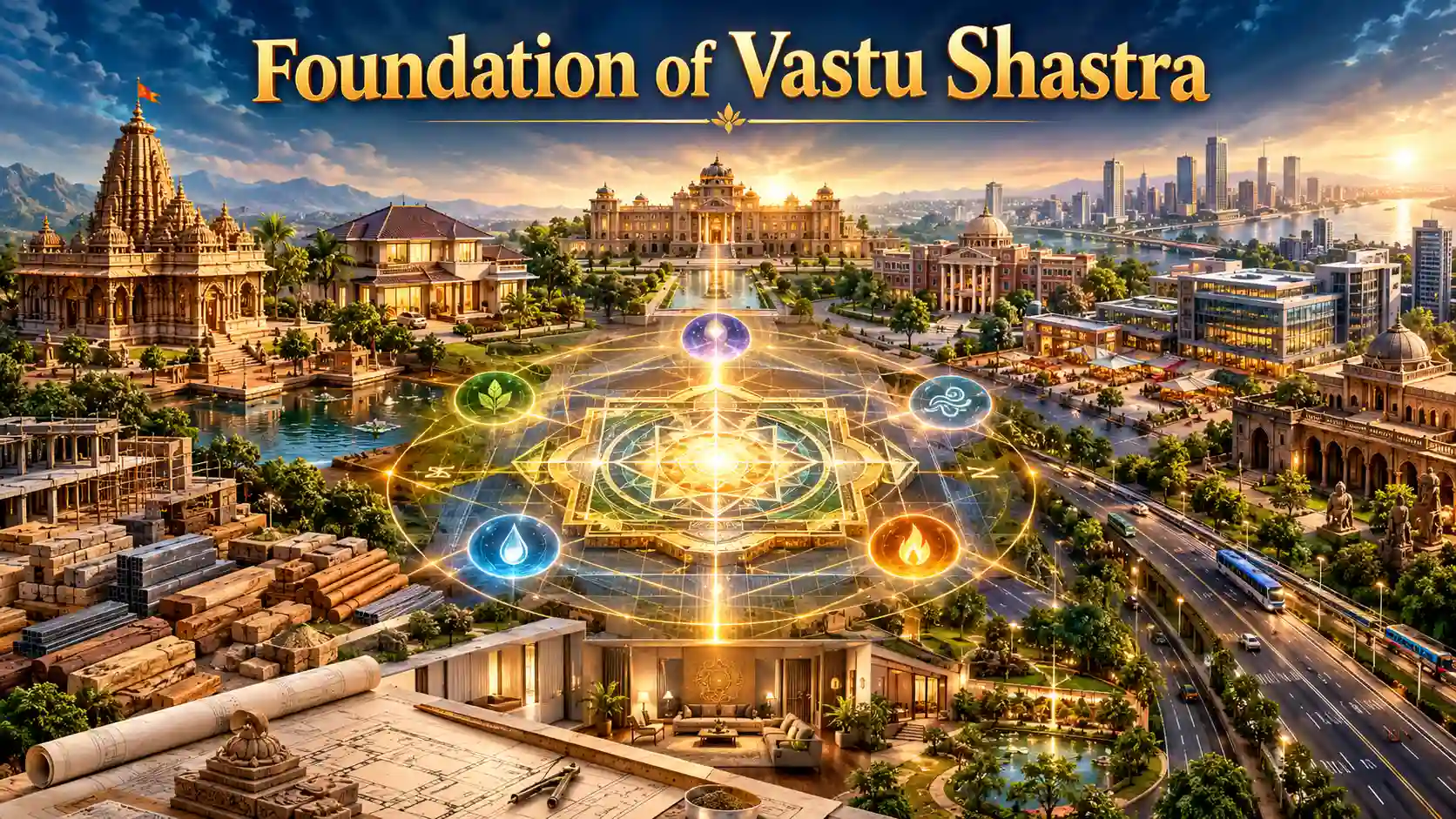
What is Vastu?
The literal meaning of Vastu is “a place where something resides.” When a space is meant to become the dwelling place of an object, a subject, or a living being, it is called Vastu — and the discipline that studies how that dwelling place should be built is called Vastu Shastra. A home, a temple, a palace, a school, an office, a museum, a travel destination, a city — these are the 8 fundamental categories of Vastu. A home houses people (and this also includes the dwelling places of animals). A temple houses the Divine — and since the Divine itself can be Sattvic, Rajasic, or Tamasic in nature, the Vastu of a temple also carries that same quality.
Vastu takes many forms, but it falls into 8 broad categories: residence, temple, palace, educational institution, workplace, tourism/heritage site, travel route, and city. The creation of Vastu, in turn, follows 8 processes: Panchamahabhuta (the five elements), Disha (direction), Mandala (structural blueprint), Maan (measurement), Maal (material), Sarani (technique/methodology), Swaroop (form/identity), and Niyojan (purpose and continuity). Of these 8 processes, every human being naturally takes an interest in two in particular — Disha and Swaroop. This is because not everyone wishes to build a Vastu, but everyone wishes to live in a Vastu they love. Direction can give a person the mental peace they desire, and form can give them the physical comfort they desire — which is why, whenever Vastu comes up in conversation, people almost always ask about direction and form.
The Categories of Vastu
Griha Vastu (Residential Vastu) – The home in which a person lives falls under this category. Houses, mansions, buildings, wadas, and chawls all belong to Griha Vastu.
Mandir Vastu (Temple Vastu) – Sanatan Dharma comprises 6 sects and 3 gunas (qualities), and the architecture of each sect’s temple differs accordingly. Temples, monasteries, ashrams, and samadhi sites of every sect fall under this category.
Rajmahal (Palace Vastu) – The dwelling place of kings and ministers — royal courts, parliament buildings, and the like — fall under this category.
Vidyalaya (Educational Vastu) – All schools, colleges, universities, libraries, and research centers fall under this category.
Karyalaya (Commercial/Office Vastu) – All factories, offices, malls, shopping centers, and marketplaces fall under this category.
Sangrahalaya (Museum Vastu) – All types of museums and tourist/heritage sites fall under this category.
Yatra Sthal (Travel Vastu) – All travel destinations such as bus stops, railway stations, airports, and ports, as well as all types of travel routes such as roads, highways, and bridges, fall under this category.
Nagar (Urban/City Vastu) – Building a complete city by placing residential settlements, marketplaces, industrial zones, roads, highways, and playgrounds each in their designated location falls under this category.
The Processes of Vastu
1. Panchamahabhuta (The Five Elements)
Before creating any Vastu, the existence and availability of the five great elements is examined — Bhoomi (earth), Jal (water), Agni (fire), Vayu (air), and Akash (space), in that exact order. Earth is examined first: is the land suitable for construction, and can it bear the load of the structure? Next, water is examined: once the Vastu is built, will it receive an adequate and continuous water supply, and can the required quantity be met? Then the continuity of fire is examined. Electricity, light, internet, heat, cooking gas, and petrol are all forms of fire — so it is examined whether the Vastu will receive an adequate supply of these. Next, air is examined: is the air present in the surrounding environment suitable for this Vastu? The journey required to reach the Vastu also falls under this category of air — it is examined whether accessible travel to the Vastu is available, and whether visitors will actually be able to reach it. Finally, the position of planets and constellations in the sky is examined. Certain spiritual structures, such as temples and pilgrimage sites, are built based on planetary and astrological positions, so checking the position of celestial bodies before construction becomes essential for these. In this way, the first process of Vastu creation is completed by examining the Panchamahabhuta.
2. Disha (Direction)
The earth revolves around the sun while spinning on its own axis, so the direction of the sun, moon, and other celestial bodies relative to the earth keeps changing. However, structures on earth remain fixed at one location and appear fixed as well — so the direction of a Vastu is likewise fixed. The direction of a structure functions as its ventilation for energy: whether positive or negative energy is present in a Vastu depends on direction, because the flow and nature of energy differs from one direction to another. Since direction is a spiritual subject within Vastu, some people mistake direction alone for the entirety of Vastu Shastra — whereas direction is, in fact, just one of the 8 processes of Vastu. In every Vastu, the flow of spiritual energy moves in 8 directions, and the flow of spiritual power moves in 2 further directions — upward and downward. This makes a total of 10 directional flows. Every Vastu has 2 kinds of direction — external and internal. To determine the external direction, sunrise is taken as due east, and the remaining directions are set relative to it. To determine the internal direction, the Vastu’s entry gate is taken as due east, and the remaining directions are set relative to it. A Vastu whose entry gate faces east will have identical internal and external directions; but a Vastu whose entry gate faces any other direction may have different internal and external directions. When a Vastu is more heavily influenced — or likely to be influenced — by outside people and outside energy, external direction should be given priority in construction. When a Vastu is more heavily influenced — or likely to be influenced — by the people and energy within it, internal direction should be given priority.
| Direction | Deity | Emotion (Bhaav) | Energy |
|---|---|---|---|
| East | Indra | Joy | Beginning |
| Southeast (Agneya) | Agni | Pleasure | Movement |
| South | Chandra | Love | Love |
| Southwest (Nairutya) | Kama | Desire | Romance |
| West | Varuna | Knowledge | Contemplation |
| Northwest (Vayavya) | Vayu | Peace | Rest |
| North | Surya | Purity | Openness |
| Northeast (Ishaan) | Dhruva | Liberation | Freedom |
When a Vastu contains other, smaller structures within it, each of those inner structures will have its own separate internal and external directions — the direction of the main Vastu and the direction of the structures within it should not be treated as one and the same.
3. Mandala
The Mandala is the basic structural framework of a Vastu. Before construction begins, a Vastu’s Mandala must be created — the Vastu must be broken down into its separate parts, and then a blueprint must be drawn up to connect those parts to one another perfectly; that blueprint is the Mandala. If there is a flaw in a Vastu’s Mandala, then after construction, certain parts of the Vastu will fail to connect properly with one another — a walk that should have taken 4 steps to get from one room to another might end up taking 40. This is why, before construction begins, it is essential to think through and plan how all the parts of the Vastu will connect with one another, and to create the Mandala accordingly.
The Mandala is not merely a blueprint of physical connections — it is also a cosmic connection. This cosmic connection arrives from 2 directions: above and below. This is why, to create a spiritual Mandala, a Mandala design must be made either on the ceiling or on the floor. A Mandala present on the floor draws energy from the floor/earth, while a Mandala created on the ceiling draws energy from the surrounding atmosphere. Every Mandala also exists in one of 2 patterns — calm or intense.
4. Maan (Measurement)
Mathematical formulas must be used to determine the measurements needed for Vastu construction. To keep the depth, length, height, and width of every space precise, one must know the correct mathematical formulas — these formulas are used to assign a fixed depth, length, height, and width to the various spaces and parts of the Vastu.
5. Maal (Material)
The substance required to build a Vastu is called Maal. Every Vastu requires different materials — the wrong material might give a Vastu an existence of only 2 days, while the right material can give it an existence of 2 centuries. This is why selecting the right material for construction is extremely important. Materials come in many types and categories: some give strength and shape, some give color and appearance, some provide grip, and some provide shine. Using the appropriate materials in construction gives a Vastu its fundamental form.
6. Sarani (Technique/Methodology)
Using the chosen materials correctly is called Sarani. A material may be of excellent quality, but if the technique used to apply it is wrong, the Vastu will turn out flawed — and in that case, it is not the material that is at fault, but the Sarani. This is why knowing which material to use, in what manner, when, and how is the fundamental requirement of Sarani. Only someone who knows how to correctly use a material can create the Sarani for that Vastu. Some materials need little water, others need a great deal; some materials must never be exposed to fire, while others absolutely require it — the Sarani of a Vastu must be built with full knowledge of such details.
7. Swaroop (Form/Identity)
No Vastu is ever built merely to be looked at from the outside — it is built to house and showcase the interior that exists within its four walls. The identity a Vastu receives from that very interior is its Swaroop. The true identity of a Vastu lies in what exists inside it. No matter how well a Vastu is constructed, if it lacks an interior — or has the wrong interior — it loses its Swaroop. If a temple has no idol of God inside it, no bell, no sanctum sanctorum, then no matter how grand or beautiful that temple looks from the outside, it will not attain the Swaroop of a temple. This is why anyone wishing to give a Vastu its finest possible form must have knowledge of interiors. In truth, the most important part of a Vastu is its interior — it is what gives the Vastu its Swaroop, and it is to attain that very Swaroop that people have interior work done within their Vastu, following the Swaroop process of Vastu Shastra.
8. Niyojan (Purpose & Continuity)
The most important point in bringing a Vastu into true existence is Niyojan. Why is the Vastu being built, and once built, for what purpose is it being used — continuously fulfilling that original purpose is Niyojan. As long as the purpose remains alive, the significance of that Vastu remains alive; once the purpose ends, that Vastu begins to turn into a ruin. This is why, whatever the reason behind building a Vastu, keeping that reason alive is Niyojan itself. If a home was built for peaceful living, then to preserve that peace, no member of the household should ever taunt one another — and neighbors should certainly never be taunted either. If a temple was built for devotion, then devotion must be practiced continuously. If a mall was built for commerce, then a plan must be made to keep that mall running continuously.
Conclusion
Vastu, then, is not a single idea confined to direction or decoration — it is a complete science built on 8 categories and 8 processes, each carrying equal weight. A Vastu comes into true existence only when its land, water, fire, air, and sky are examined; when its direction is fixed; when its Mandala is planned; when its measurements are precise; when the right material is chosen; when that material is applied with the right technique; when its interior gives it a true form; and when the purpose behind it is kept alive continuously. Miss even one of these 8 processes, and a Vastu remains incomplete no matter how grand it appears from the outside. This is why anyone wishing to understand Vastu in its true sense must understand all 8 processes together — not direction alone, and not form alone — because it is only the union of all 8 that gives a Vastu its complete existence, and it is only continuous Niyojan that keeps that existence alive.