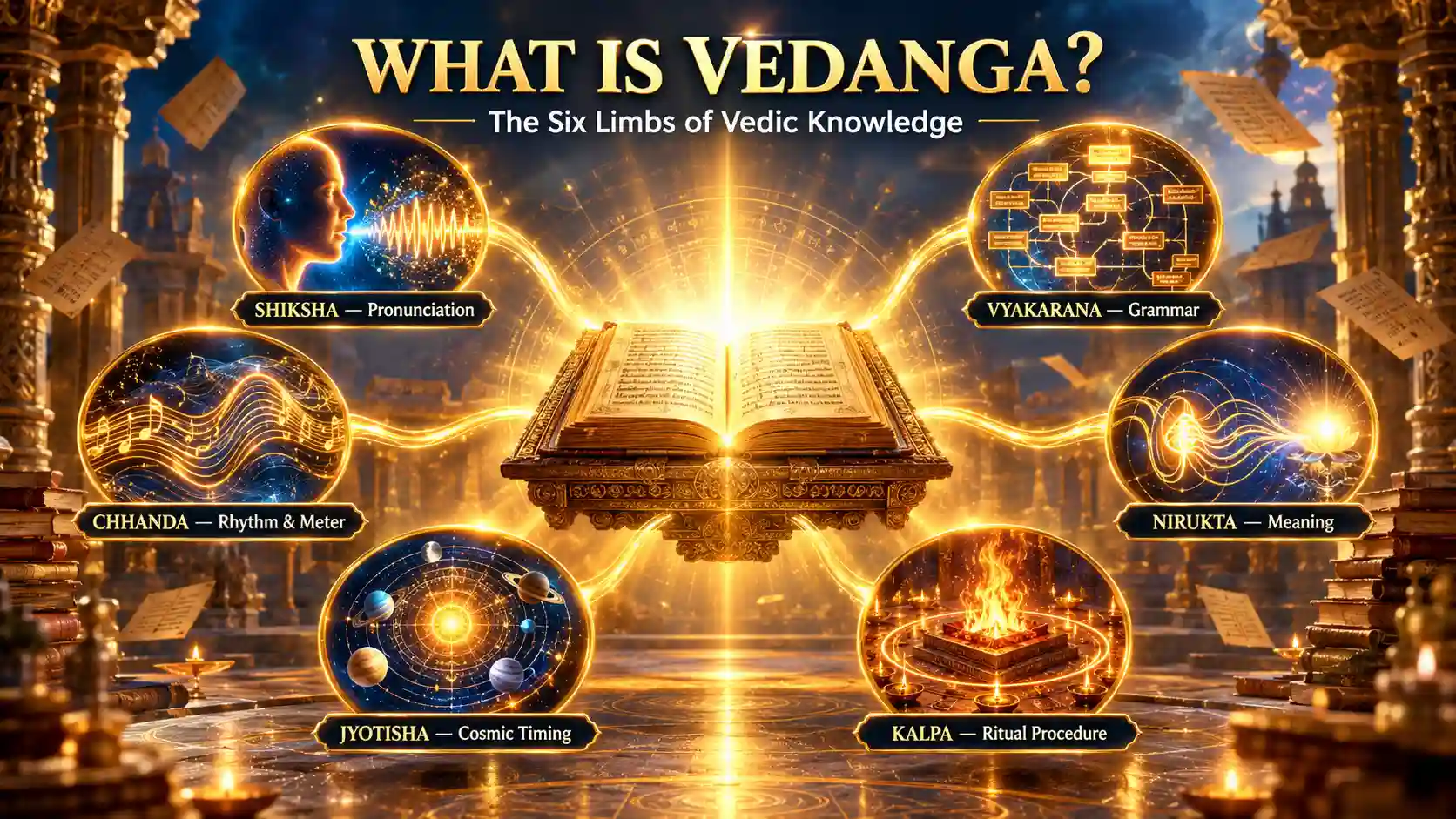
What is Vedanga?
Vedanga is made of 2 words: Veda and Anga, meaning the limb of the Vedas.
The Veda is the product, and Vedanga is the technique to create that product and the process to use it.
Shiksha, Vyakarana, Chhand, Nirukta, Jyotish, and Kalpa are the 6 limbs of Vedanga.
Vedanga does not belong to any one language — every language has its own limb of the Vedas.
The Vedanga of Vedas written in Marathi is in Marathi, the Vedanga of Vedas written in Hindi is in Hindi, the Vedanga of Vedas written in Sanskrit is in Sanskrit, and the Vedanga of Vedas written in English is in English.
Using Vedangas, Vedas can be composed in any language — Veda and Vedanga complement each other.
Without Vedanga, Vedas cannot be composed, and they cannot be used correctly either.
That is why to learn the Vedas, learning Vedanga first is essential.
When the practice of Vedanga in a language stops, the Vedas written in that language slowly come to an end.
The Veda is not merely knowledge — it is a collection of poetry, knowledge written in a musical, rhythmic form.
And writing or reciting that poetry is only possible when there is knowledge and practice of Vedanga.
1. Shiksha
Speaking words correctly is Shiksha.
There is no Veda without words.
That is why the first step is learning to speak words.
Learning to pronounce every single word found in the Vedas is called Shiksha.
Shiksha has many meanings, but when it comes to Vedanga Shiksha, it has only one meaning: learning to speak the words of the Vedas.
Shiksha is the practice of speaking the words of the Vedas with correct pronunciation of Varna (letters), Swar (vowel tones), Uchcharan (articulation), Matra (duration), Bal (stress), Sama (evenness), Sandhi (joining of sounds), and more.
2. Vyakarana
Correctly writing and speaking two or more words together is Vyakarana (Grammar).
The Veda is a matter of language, so correctly writing and speaking two or more words of the Vedas together is Vyakarana.
Without understanding Vyakarana, the Vedas cannot be read or spoken.
When someone tries to read the Vedas without learning Vyakarana, they join 3 words together instead of 2, and the original form and meaning of the Vedas fall apart.
As a result, speaking the Vedas becomes meaningless.
My mother tongue is Marathi.
When I try to read Vedas written in another language, such as Sanskrit, I do not have knowledge of Sanskrit Vedanga, so I end up reading 2-3 words together, pronouncing them incorrectly, and reciting those Vedas becomes meaningless for me — I myself become meaningless.
But when I read Vedas in Marathi, because I have knowledge of Marathi Vedanga, I read them correctly, and I grasp the meaning.
That is why, whatever language’s Vedas you want to read and speak, practice of that language’s Vedanga is necessary.
3. Chhand
The Veda is a poetic composition — it has to be sung in a rhythmic manner, so that during worship, havan, bhajan, kirtan, and other rituals, an extraordinary flow of energy keeps circulating.
A Veda sung rhythmically activates spiritual energy within both the singer and the listener.
To sing the Vedas rhythmically, practice of the melody and rhythm of the words is required — this is called Chhand.
Without Chhand, words are without emotion.
To bring emotion into words, words must be transformed into Chhand.
Whoever has knowledge of Chhand is able to transform words into Chhand.
4. Nirukta
Knowing the meaning of words is Nirukta.
Nirukta is the most important limb of the Vedas.
Nirukta is the point of origin of the composition of the Vedas.
Before the Vedas are composed, a thought arises; that thought then takes the form of understanding; and to present that understanding, a word is found — that word is Nirukta.
Nirukta is the word in which the understanding of the Vedas’ knowledge is presented.
When someone knows the meaning of the words of the Vedas, knows their Nirukta, they gain understanding of the knowledge of that Veda.
When someone does not know the meaning of the words, they can speak the Vedas, but they can never know their meaning.
The core purpose of the Vedas is not only to perform rituals, but also to spread knowledge through the Vedas.
But when the meaning of the words of the Vedas is not known, one can perform the ritual of the Veda but cannot spread the knowledge along with it.
Nirukta is made of 2 words: Neer, meaning clear, and Vakt, meaning to present a particular thought.
So Nirukta means the word that clearly presents a thought.
In the Vedas, every instance where 2 or more words combine to form one word, or where 2 separate words come together to form one meaning — the study of all of this is called Nirukta.
Nirukta gives meaning to the Vedas.
Words that have no meaning are never used to compose the Vedas — the Vedas are always composed using words that carry deep meaning, and finding and knowing those meanings is Nirukta.
5. Jyotish
Observing the position of planets and constellations in the sky is called Jyotish.
The energy coming from planets and constellations affects human action.
While performing any ritual or rite, knowledge of Jyotish is necessary to ensure that the energy of the planets and constellations aligns with the purpose of that ritual.
A ritual performed for a specific purpose cannot be performed on just any day — on one day the energy coming from the planets and constellations may be favorable for that purpose, and on another day it may be unfavorable.
That is why, to apply the mantras of the Vedas in any ritual, checking the Muhurat (auspicious time) is necessary.
The chanting of Vedic mantras can happen without a Muhurat, a ritual can happen without a Muhurat, but in the wrong Muhurat, the chances of losing focus and facing obstacles are higher.
Just as the effect of energy is different at 4 AM and 4 PM, similarly, the flow of energy coming from the planets and constellations is different every day.
To determine the Muhurat, the position of the Sun and Moon in the constellations is checked; to determine the Muhurat based on other planets, the transit of the Moon into that planet’s position on a given day must also be checked.
In Vedanga, the limb of Jyotish is not for reading anyone’s horoscope — it exists purely for determining the Muhurat.
Whoever has knowledge of the Muhurat can easily recite the Vedas at a good Muhurat and make the practice of the Vedas simple.
The primary purpose of Vedanga Jyotish is to determine the appropriate time or period for a Vedic ritual.
This very process of determining the appropriate time is called finding or determining the Muhurat.
6. Kalpa
The method of performing a ritual, and which Vedas to recite while performing which method — this is called Kalpa.
The true meaning of Kalpa is a complete cycle.
All the limbs of Vedanga are given completeness by the method — that is why the method is called Kalpa.
Just as the Earth’s complete orbit around Vaikuntha is called a Kalpa, similarly, the final practice-method of Vedanga is called Kalpa.
When all the limbs of Vedanga come together and perform one method, Vedanga attains completeness — that completeness is called Kalpa.
Every ritual has a different method of being performed.
A person can either create a method for performing a ritual, or follow a method created by someone else.
So whoever wants to perform a ritual must either follow the methods of others, or, if they do not want to follow others’ methods, they must create a new method themselves.
In the past, many different methods were followed — people followed the ones they found favorable, and created their own methods where existing ones felt unfavorable.
Today, many ancient methods have come to an end, and new methods have been invented — and this process will continue in the future.
That is why no single method should ever be considered final or the only method.
All the other limbs of Vedanga use a fixed technique that never changes.
Kalpa is the only limb that keeps changing continuously.
The process of speaking, reading, and knowing any Veda never changes, but a Veda’s mantra, through changes in Kalpa, can be transformed from one method into 4 different methods — and even after these changes, when the Veda is spoken, the form of the Veda does not change, but the Kalpa has changed.
There is no single fixed method for performing any ritual, but a ritual cannot happen without a method — so every ritual definitely has a method, and practicing that method is called Kalpa.
Conclusion
Vedanga and Veda are not separate — the technique of writing, speaking, and applying the Vedas in ritual through method is Vedanga itself.
The Veda is not the mantra of just one language — bhajans, kirtans, shlokas, chhands, poems, and all such compositions written in every language for dharma and God are Vedas.
To speak Marathi Vedas, practice of Marathi Vedanga is necessary.
To speak English Vedas, practice of English Vedanga is necessary.
To speak Tamil Vedas, practice of Tamil Vedanga is necessary.
In the same way, to speak Sanskrit Vedas, practice of Sanskrit Vedanga is necessary.
If even one of the six limbs of Vedanga is not practiced, the Veda cannot be spoken.
Without practice of language, words cannot be spoken at all.
Without practice of Vyakarana, words can be spoken, but joining different words together will corrupt the pronunciation of the Vedas.
Without practice of Chhand, the Veda can be spoken, but it will have no emotion and no feeling in it.
Without practice of Nirukta, the Veda can be spoken, but its meaning cannot be known.
Without practice of Jyotish, it will be spoken at the wrong time, without Muhurat.
Without practice of Kalpa, the Veda can be spoken, but the method of any ritual cannot be performed.
That is why, to practice the Veda, all 6 limbs of Vedanga must be practiced together — they are not to be treated as separate subjects.
The most important point: everyone does not need to learn Vedanga — only Purohits (priests) need to learn it.
Rishis, Maharishis, sadhus, saints, and householders have no need to learn Vedanga, because they do not run a business of performing worship and rituals in other people’s homes.
Performing worship and rituals in other people’s homes, or performing worship in temples, is the business of Purohits and the job of a priest — they must learn Vedanga.
Just as mathematics is compulsory for an engineer, and medicine is compulsory for a doctor, Vedanga is compulsory for a Purohit — but for people of other professions, learning Vedanga is not compulsory.
However, when a seasonal businessperson or a government employee wants to work part-time as a Purohit, then learning Vedanga becomes compulsory for that businessperson or government employee as well.