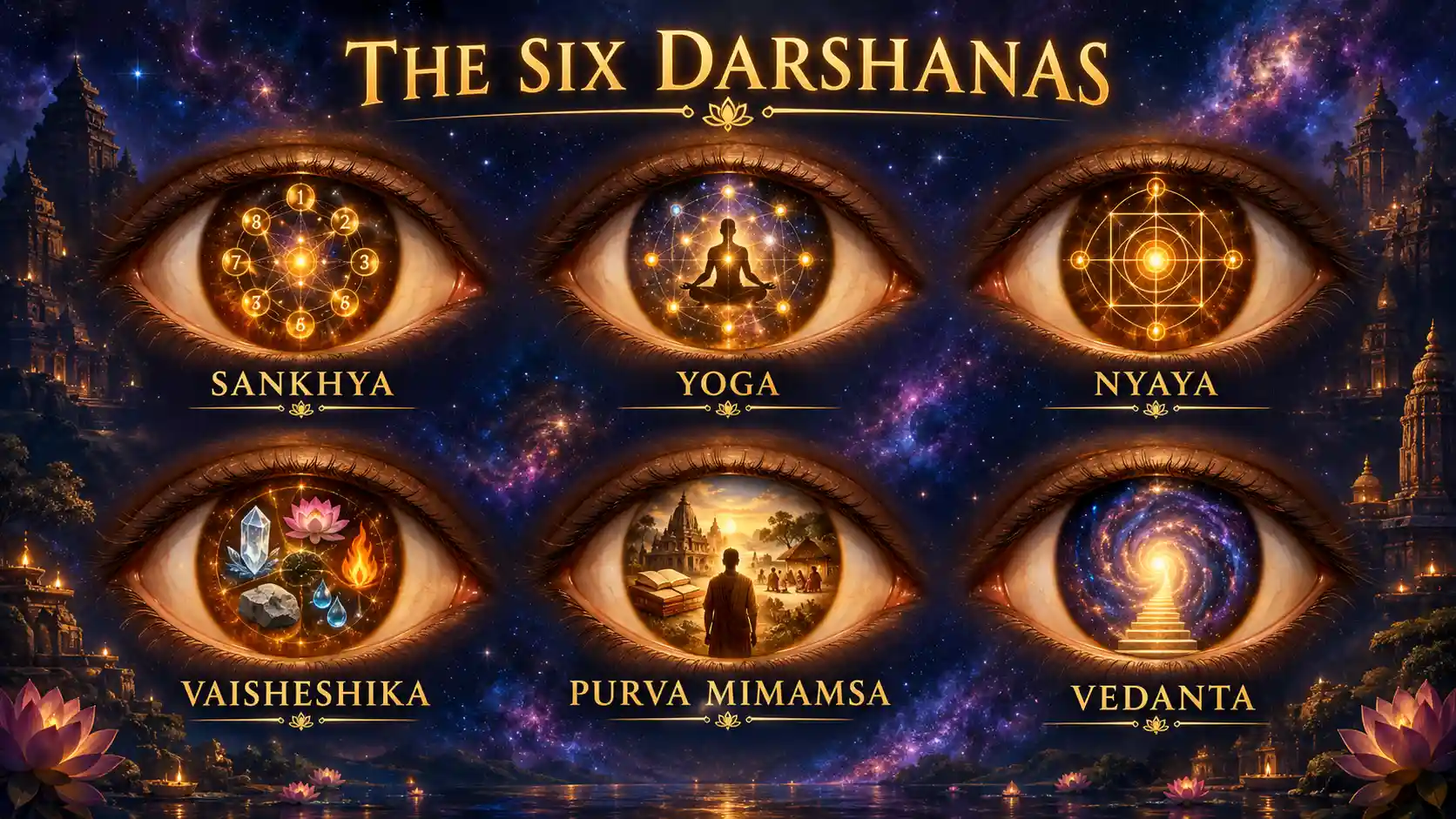
The Six Darshanas
Darshana means to see, to know, to feel. There are 2 types of darshana — physical darshana and spiritual darshana. Physical darshana has six parts — eyes, ears, tongue, nose, skin, and brain. Physical darshana is performed through these six parts.
Seeing with the eyes, hearing with the ears, tasting with the tongue, smelling with the nose, feeling with the skin, and inferring with the brain — these 6 actions are the 6 physical darshanas. In the same way, Sankhya, Yoga, Nyaya, Vaisheshika, Purva Mimamsa, and Vedanta are the 6 spiritual darshanas.
In spiritual darshana, the 6 actions of seeing with the eyes, hearing with the ears, tasting with the tongue, smelling with the nose, feeling with the skin, and inferring with the brain cannot be performed. Therefore, when someone tries to see spiritual darshana through these six parts — eyes, ears, tongue, nose, skin, and brain — spirituality does not appear to them, and they then begin to call spirituality false, while they themselves are using the wrong way of seeing spirituality.
The darshana of spirituality can only happen through the 6 parts of Sankhya, Yoga, Nyaya, Vaisheshika, Purva Mimamsa, and Vedanta. Whoever tries to see through these six parts attains the darshana of spirituality.
1. Sankhya Darshana
Every single object in creation is formed by the coming together of various elements; no object is made of a single element by itself. Knowing the number of the various elements of any object or subject in order to understand it is Sankhya darshana.
Knowing that there are 24 hours in a day is Sankhya darshana. Knowing that a muscle of the human body is made of 8 elements is Sankhya darshana. Knowing that the constellations are spread across 12 directions is Sankhya darshana.
Knowing the number of elements and principles of any subject or object is Sankhya darshana. When a human being uses Sankhya darshana to look at a subject, they begin to gain an understanding of all the elements connected to that subject.
2. Yoga Darshana
In creation, every single object is connected to some other object; no object is alone or independent. Knowing and understanding how a particular object, state, or subject is connected to other subjects is Yoga darshana.
The real meaning of Yoga is “to join.” Purushartha is connected to the 4 subjects of Dharma, Artha, Kama, and Moksha — knowing how it is connected and why it is connected is Yoga darshana.
In the same way, every subject is connected to some other subject, and knowing those connections is Yoga darshana. Ashrama is a subject; Ashrama means a stage of life.
Counting how many stages come in a human’s life is Sankhya darshana, but knowing how all those stages are interconnected is Yoga darshana. In a human’s life, first comes the stage of intellectual and physical development, called Brahmacharya Ashrama.
Then comes the stage of taking up a job, getting married, and fulfilling family responsibilities, called Grihastha Ashrama. Then, for the sake of progress and to obtain a good job or business, one has to go and live away from home — this is called Vanaprastha Ashrama.
Then, in old age, one has to renounce one’s job or business, or renounce one’s family responsibilities, which is called Sannyasa Ashrama. When Ashrama and the stages of life were connected through Yoga darshana, the true darshana of Ashrama took place.
In the same way, looking at any subject by connecting it to its other related components is called Yoga darshana.
3. Nyaya Darshana
Every subject in creation is made of a specific number, is made by joining specific components, and — most importantly — is made on the basis of specific rules. One subject may be made up of only 3 components while another is made up of 4 components; one element may be connected to a subject from only 2 directions while another element is connected from 6 directions.
But how many components a subject will have, and how many elements a subject will remain connected to, happens only on the basis of specific rules, and knowing those rules is Nyaya darshana. Nyaya exists where there is a rule; where no rule has been made for a subject, there is no Nyaya for that subject either.
For example, there are 3 rules of Creation:
- The rule of duality
- The breaking of peace
- The planning of shape/form
That is, when an object is created at a place of duality, it becomes necessary to also create an object of the opposite nature. To create an object, peace must be broken — where there is peace, creation cannot happen, and where creation is happening, there cannot be peace.
To create any object, its shape must be determined — without planning the shape of an object or subject, it cannot be created; and even if it is created, what is made will be a different thing altogether.
4. Vaisheshika Darshana
In creation, every single object has been given a specific quality or property (gunadharma) that grants it existence. Any object or subject gets its identity from its qualities. Recognising and knowing the qualities of an object is Vaisheshika darshana.
When the number of components present in an object increases or decreases, its qualities change. When an object becomes connected to different elements, its qualities change. When every object is bound by different rules, its qualities change.
Therefore, when someone looks at an object through Vaisheshika darshana, the qualities of that object begin to become visible to them. Until a person looks at an object or subject through the Vaisheshika lens, the qualities of that object or subject do not appear to them.
5. Purva Mimamsa
Every physical and spiritual subject or object present in creation is connected to some living being or human being. Connecting those subjects and objects to living beings and humans is Mimamsa darshana.
When various subjects are looked at by connecting them with one another, that is called Yoga darshana; but when the same subject is looked at by connecting it to a living being or human, that is called Mimamsa. When those subjects are looked at by connecting them with past experiences and events, that is called Purva Mimamsa.
Through Mimamsa darshana, it is seen how a subject is connected to human life. Through Purva Mimamsa darshana, it is known how any subject is connected to a human’s past.
6. Vedanta
Behind the existence of every single object and subject present in creation, there is a cause, and that is called the ultimate truth. When the root cause behind the existence of an object or subject is known, that is called Vedanta.
Vedanta is formed from 2 words — Ved and Anta. Ved means knowledge, and Anta means final or end — that is, the final knowledge is called Vedanta.
The Vedanta darshana of every object or subject is different. The existence of every object or subject is different for each individual. When something is very necessary for one person, that same thing can be useless for someone else.
Therefore, the existence of an object is not the same for everyone — this itself is the nature of Vedanta. Vedanta does not function in the same way for all human beings.
When someone comes to know that they have to work a job throughout their life, that too is Vedanta darshana. When someone comes to know that they have to invent something, that is Vedanta darshana for them.
When someone comes to know that they have to become wealthy through a particular business, that is Vedanta darshana for them. When someone comes to know that they have to become a monk and preach religion, that too is Vedanta darshana for them.
Through Vedanta darshana, a human comes to know the root cause of the existence of their own life, and that is the final knowledge which it is necessary for everyone to know.
Conclusion
When creation began, only 8 dimensions were active, which could be seen and counted only through Sankhya darshana. Then all 8 dimensions became connected with one another, and their mutual connections could be seen only through Yoga darshana.
Then all 8 dimensions, having joined together, became bound by specific rules in order to perform specific functions, and those rules could be known only through Nyaya darshana. Then, as all 8 dimensions were observed performing actions, their qualities began to appear, and those qualities could be known only through Vaisheshika darshana.
Then, in order to experience all those 8 dimensions, living beings and humans were created in creation, and they became connected to those dimensions. This connection could be seen only through Purva Mimamsa darshana.
Then, instead of looking at the outer dimensions, humans looked within, at the root cause of their own existence, which could be seen only through Vedanta darshana.
In this way, in a human’s life, Sankhya darshana arises first — children choose to count the objects they have. Then, to know who among their friends they are close to and with whom they have a good connection, they adopt Yoga darshana.
Then, to establish rules about whom to maintain relationships with and under what conditions, they adopt Nyaya darshana. Then, to analyse what skills or abilities exist within themselves and what skills or abilities exist in others, they adopt Vaisheshika darshana.
Then, to reflect on how an event is connected to their own past and present, they adopt Purva Mimamsa. Then, to know what the root purpose of their life is and what work they were born to do, they adopt Vedanta darshana.
In this way, the six darshanas come at different stages in the life of every human being. This article gives only an introduction to the six darshanas.
To understand each darshana in detail, you should read the independent articles written on Sankhya, Yoga, Nyaya, Vaisheshika, Purva Mimamsa, and Vedanta. Each darshana has been written by a particular sage.
This does not mean that the darshana is limited to only as much as one sage has written. Rather, every sage has written from their own experience; someone’s experience may be less, and someone’s may be more.
Therefore, do not consider any book or article on a darshana to be complete. I too write about the same darshana across multiple articles.