The Decision to Learn Devotion
On June 18, 2023, I decided to deepen my spiritual journey by learning about devotional practice, and the next day, I began my journey to Vrindavan. I had already visited Rishikesh to study meditation practice and travelled to Kamakhya in 2021 to study tantra practice, so this time I felt it was the right moment to go to Vrindavan and learn about devotion.
I shared my plan with my mother. “Like last year, I want to go to Vrindavan again—this time dressed as a sadhu—to immerse myself in devotion practice.” My mother already knew my pattern. Whenever I planned a 10–15-day religious journey, I would usually return home after just 7–8 days, abandon the journey midway, and restart it later.
With a knowing smile, she warned me, “Complete the trip properly this time. Don’t come back early—I won’t let you go again.” Undeterred, I decided to travel to Vrindavan by motorcycle and plotted my route on Google Maps.
The ride took two full days. I rode during the day and slept at petrol pumps at night. The journey was mostly wonderful, except for heavy traffic in Kalyan and Mathura. Since riding a motorcycle in a dhoti was not practical, I travelled in a T-shirt and jeans.
From Devotion to Water Play
My first stop in Vrindavan was the Yamuna ghat. There, I noticed a clear difference between two groups: devotees were immersed in quiet devotion, taking holy dips with reverence, while tourists were splashing around in the water and enjoying themselves.
I parked my motorcycle and joined the devotees, taking dips alongside them in a spirit of devotion. But something did not feel right. What truly attracted me was the carefree bliss of the tourists—jumping, playing, and enjoying the water.
So I left the devotees’ group, moved to a quieter spot nearby, and began splashing around on my own. I completely lost myself in the fun. It felt so liberating that I could have stayed there for another one or two hours.
Eventually, I remembered why I had come to Vrindavan in the first place. After about an hour of pure enjoyment, I pulled myself out of the water and began changing into sadhu attire.
As I changed, two boys sitting nearby started talking to each other. One of them whispered that I was a “double-role” guy. I overheard him, looked at him, and smiled. Then he asked me directly:
“What’s this drama? Before jumping into the Yamuna, you looked like a stoner in jeans; now, in a dhoti, you look like a proper sadhu.”
I asked him, “Why did I look like a stoner?”
Both boys burst out laughing. “The way you were jumping around in the water—you definitely looked drunk!”
I replied, “Water washes away my serious nature, and I become a child again.”
They simply grinned and said, “Radhe Radhe.”
I had seen on YouTube that Sudama Ashram provided accommodation and food for sadhus. I thought staying there would give me the opportunity to meet many sadhus and learn about their different spiritual practices. With that intention, I put on my dhoti and headed toward the ashram.
The Ashram Experience
It was around 5 p.m. when I arrived, but the office was locked. One practitioner told me to wait for 5–10 minutes because the manager would arrive soon, so I settled down outside the office and waited.
Loud devotional bhajans were playing throughout the ashram. A group of devotees and sadhus had gathered outside, waiting for a programme to begin. I prefer peace and quiet, but the volume of the bhajans and kirtans was so intense that I quickly became restless.
I thought to myself, “I can’t even tolerate bhajans for two minutes. If I stay in this ashram, I’ll have to listen to them all day. There’ll be no space to meditate, reflect inwardly, or read scriptures in such an environment.”
So I quietly slipped away from the ashram. Next, I visited Malook Peeth Rajendra Das Maharaj Ashram and approached the manager with my request.
I said, “I am conducting research on Sanatan Dharma and writing a book on Sanatan scriptures. I would like to stay in your ashram for a few days to study devotion practice.”
In the office, they informed me that Chaturmas was beginning in ten days, so they could not accommodate me at that time. They suggested that I return after Chaturmas had ended.
As I stepped out of the office, I spoke with a sadhu who was sitting outside on the footpath.
Kedi: “When does Chaturmas end?”
Sadhu: “Whose dhoti are you wearing?”
Kedi: “It’s my own—I bought it from a shop. Why do you ask?”
Sadhu: “You claim to be a sadhu, yet you don’t even know about Chaturmas? You’re asking when it ends before it has even begun? Are you truly a sadhu?”
Kedi: “I have a problem with forgetting things. Right now, I’ve simply forgotten about Chaturmas.”
Sadhu: “Chaturmas lasts four months and begins on the next Ekadashi.”
I thanked him and left the ashram, making my way back to the Yamuna ghat. Sitting there, I began thinking about how I could possibly understand devotion practice without bhajan and kirtan.
The Problem with Bhajan and Kirtan
I couldn’t listen to bhajan-kirtan for very long. I could sit peacefully in one place and meditate the whole day, and I could listen to devotional songs the whole day, but if I had to listen to devotees singing bhajan-kirtan in off-key voices for more than ten minutes, I would become restless.
My own voice is so off-key that I don’t even have the capacity to listen to bhajans in my own voice. I simply couldn’t figure out how to practise devotion.
Whenever I become very troubled, I talk to Ganesh. There is another mind within me whose name is Ganesh. Ganesh is very wise and has solutions to all my troubles.
Sitting at the Yamuna ghat, confused about how I could practise devotion without being able to sit through bhajans, I turned to Ganesh—the other mind within me—for answers.
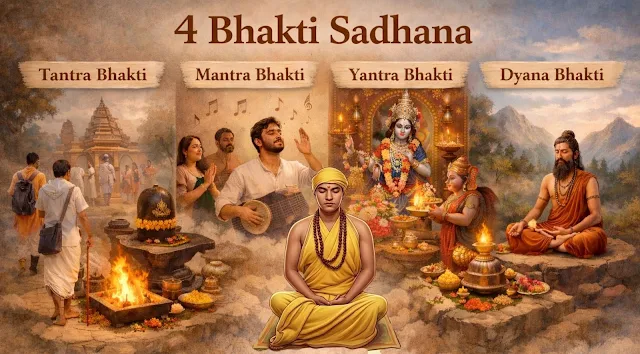
In our conversation, I learned that devotion isn’t one single path. There are four types of bhakti sadhana: Tantra, Mantra, Yantra, and Dhyana. Each person’s true devotion depends on their own nature.
Ganesh helped me discover that mine is Dhyana devotion.
Discovering My Own Path
My journey to Vrindavan began with the intention of learning devotion from sadhus, ashrams, and devotional practices. Instead, the journey took me somewhere completely unexpected.
I could not remain in the first ashram because of the loud bhajans. I could not stay in the second ashram because Chaturmas was approaching. I even arrived wearing a dhoti while having forgotten what Chaturmas was.
At the Yamuna, I tried joining the devotees, but ended up enjoying myself like a child in the water. Yet through all these unexpected experiences, I eventually discovered something important about my own nature.
Devotion does not have to look the same for everyone. My search for devotion began in Vrindavan, but the answer came through a conversation with Ganesh—the other mind within me.
That conversation led me to discover the four forms of Bhakti Sadhana and recognise Dhyana as my own path of devotion.
Curious which type of devotion might be yours?
Read 4 Bhakti Sadhana