From Civilisation to Temples
In 2016, I wanted to ride a bike across the whole of India to closely observe Indian culture and civilization. I would travel from one city to another only on my bike. My first long bike journey was in 2016, from Mumbai to Chennai. My second-longest journey was in 2017, from Mumbai to Delhi and back to Mumbai. My third was in April 2021, from Mumbai to Kolkata, and my fourth began on 2 May 2021, from Mumbai to Delhi and then to New Jalpaiguri.
Until that point, I had never travelled by bike to visit a temple. My journeys were focused only on studying the civilization, culture, and mindset of people in different villages and cities across India. In 2021, I lived like a sanyasi for one full month at Gita Bhawan in Rishikesh. There, Dinaanath Maharaj told me that if I wanted to understand Indian civilization, I also needed to enter temple complexes because a major part of Indian civilization existed within temples and their premises.
In August 2022, I started planning my first religious bike pilgrimage. I decided to ride along India’s southern coastal border, visit famous religious places and temples along the way, and observe the civilization within those temple premises. I created a route from Mumbai to Visakhapatnam, then Kanyakumari, and finally back to Mumbai—a total journey of about 5,000 km.
Once the route was fixed, I selected the temples I could visit along the way. From Mumbai to Visakhapatnam, I planned Pandharpur and Tuljapur. From Visakhapatnam to Kanyakumari, I planned Tirupati Balaji, Thanjavur, and Rameswaram. On the return journey from Kanyakumari to Mumbai, I planned to visit Padmanabhaswamy Temple and Ganapatipule. At this point, I thought I was planning a religious journey, but I still had no idea what the journey would eventually become.
The Pilgrimage on a Broken Bike
My bike was in terrible condition. Many parts were broken, and repairing or replacing them would have cost around ₹30,000. The bike was 15 years old, second-hand, and I had bought it in 2011 for ₹28,000 after it had met with an accident. By then, I had ridden around 120,000 km, while the previous owner had ridden another 40,000 km. In 2017, I had changed the engine for ₹4,500, so the engine was still running well, but almost everything else was worn out.
Both wheels were slightly bent, the handle was crooked, the indicators were dead, the speedometer was broken, the battery was dead, the shock absorbers were gone, the rear tyre was completely bald, the chassis was bent, the drum brakes were worn out, and the bearings kept breaking. For this religious journey, I had money only for petrol. I could not repair the bike, stay in hotels, or buy anything extra. Still, I decided to undertake the journey on the same battered machine.
If I sold the bike, I would not have received more than ₹10,000. So I decided that if the bike broke down somewhere and could not be repaired, I would leave it there and return home. Until that happened, however, I would continue travelling as far as the bike could take me. I told my mother that petrol would cost a lot, I would not be able to stay in hotels, and I might have to sleep on the ground somewhere, so I asked her for a bedsheet.
She gave me one. Whenever I travelled, I would spread that sheet at a safe place, usually a petrol pump, and sleep there. On 3 August 2022, I left home at 6 a.m. and reached Pandharpur by 5 p.m. There was no festival that day, so the temple was not crowded. My original purpose was to study the civilization inside the temple premises, and around the Pandharpur temple I saw Maharashtrian Warkari devotees continuously singing bhajans and kirtans, with Tulsi malas everywhere in the shops.
The traditional Maharashtrian atmosphere was visible everywhere. I had darshan in just 10 minutes and, after observing the culture, immediately left for Tuljapur. I reached there by 8 p.m. That day I had ridden around 500 km in 12 hours, stopping frequently so the engine would not overheat. I was exhausted and first started looking for a dharamshala before going to the temple.
I asked a taxi driver whether there was any dharamshala because my budget was only ₹200. He told me there was a lodge for ₹300, while the others cost ₹800 or more. I went there, and the lodge owner told me that there was no crowd at the moment and advised me to go for darshan that night because there would be a rush in the morning. I quickly bathed, went to Tulja Bhavani Temple, took a token, and entered.
It was around 9 p.m., and only 10–12 devotees were ahead of me. Because it was night and there was no festival, there was almost no crowd, and I had darshan in about five minutes. The energy at Tulja Bhavani felt completely different from Pandharpur. Pandharpur had felt deeply devotional and serene, while Tulja Bhavani felt fierce and powerful. After darshan, I returned to the lodge and fell into deep sleep the moment I lay down.
4,600 Kilometres of Heat and Hunger
From Tuljapur to Visakhapatnam, there were no temples on my route, so I focused only on observing people in villages and towns. Between Tuljapur and Vijayawada, the bike broke down, but fortunately it happened directly in front of a petrol pump with a mechanic next door. The bike was repaired quickly, and I continued the journey.
The summer heat was unbearable. My lips developed blisters, my eyes became sticky, my whole body felt like it was burning, and there was almost no tree providing shade. Finally, around 3 p.m., I found a tree, spread my bedsheet beneath it, and slept for an hour. Later, at around 10 p.m., I became so sleepy that I knew riding even another kilometre could cause an accident.
The first petrol pump I reached refused to let me sleep there, so I continued riding and found three men chatting in a small settlement. I asked whether there was a dharamshala nearby, and they told me the nearest ones were 40 km away in Vijayawada. Forty kilometres felt almost impossible at that moment, but a bus was travelling in the same direction, so I followed it at around 70–80 km/h to stay awake and eventually reached Vijayawada at 11 p.m.
All the dharamshalas were closed, but after pleading with one of them, I was given a room for ₹200. The next morning at 6 a.m., I left for Visakhapatnam, around 400 km away. I stopped only once for food and kept stopping every 100 km to cool the engine. I reached Visakhapatnam at 6 p.m., spent some time by the sea, and left again at 8 p.m. I rode through the night, reached Vijayawada again at 9 a.m., and then took the road toward Chennai.
The village and town names were written in completely different languages, and I could neither pronounce nor remember many of them, so I relied heavily on Google Maps. Tirupati and Thanjavur were 500–700 km away from my coastal route, so I cancelled those plans and headed directly toward Rameswaram. From the hotel where I made that decision, Rameswaram was still 800 km away.
I rode continuously for two days and one full night before reaching Rameswaram Temple at around 10 p.m. I took a ₹300 room in a dharamshala and went for Shiva Linga darshan the next morning. The moment I saw the Linga, tears started flowing from my eyes for the first time in my life. I did not know whether I was crying because of physical pain, hunger, helplessness, exhaustion, or simply because I was standing before God.
At 7 a.m., I went to Dhanushkodi. The scenery was breathtaking, with sand blowing across the road. My bike skidded, but I slowed down in time. I tried to meditate, but the wind was too strong. Still, I sat quietly for around two hours, absorbing the natural surroundings and the music of the wind.
On the way from Dhanushkodi toward Padmanabhaswamy Temple, the bike broke down again because the chain kept slipping. I somehow managed to ride about one kilometre to a mechanic, who tightened the chain. I eventually reached Padmanabhaswamy Temple at around 10 p.m., parked outside, and went for darshan, only to find that the temple was closed.
Fortunately, there were dormitory beds inside for ₹200. I bathed, slept there, and attended the first aarti at 4 a.m. After darshan, I spent time observing Kerala’s beautiful temple culture, something I felt was rarely visible outside temple premises. After another two days and one night of continuous riding, stopping every 100 km to cool the engine and sleeping on my bedsheet under trees or at petrol pumps, I eventually reached Goa.
Goa, Ganapatipule and the Missing Puja
I reached Goa at around 10 a.m. and parked at Calangute Beach. I walked around Calangute and Baga, played in the sea, and later enjoyed the colourful lights and music in the evening. My eyes burned from the salt water, but I continued enjoying the atmosphere. I did not drink, so I simply sat outside a restaurant listening to live music.
The music was so energetic that I started dancing alone, and soon a group of boys joined me. Later, while wandering around near a pub at night and thinking about my poverty and misfortune, a boy approached me and said, “Come with me.” I told him, “I’m Kedi. Who do you want to meet?” He made a gesture that I did not understand and pointed toward the pub.
I told him that I did not even have money for a biryani, so I could not go inside the pub. He left without saying anything, and that was when I decided to leave Goa. I left at 1 a.m. for Ganapatipule. My body was itchy from dried sea salt, so at 2 a.m. I bathed in a petrol-pump toilet. It was the first time I had ever bathed at night during a journey.
I reached Ganapatipule at around 10 a.m. and parked in a lane directly opposite the main temple gate. There was no festival and no crowd, with only two devotees ahead of me. I had darshan of God Ganapati in just two minutes. The temple was directly beside the sea, and after darshan I sat on the beach, enjoying the strong sea breeze and finally feeling that my first religious journey was almost complete.
Only the ride from Ganapatipule back to Vashi remained. I was sitting peacefully on the beach when something suddenly struck me. I had visited five major temples—Pandharpur Vitthal-Rukmini, Tulja Bhavani, Rameswaram, Padmanabhaswamy, and Ganapatipule—but I had not offered a single proper prayer. I had not asked for anything, offered flowers or fruit, or even said “thank you” to God. I had only folded my hands and bowed.
I became disturbed by the thought. I had travelled around 4,600 km alone on a broken bike, visited five great temples, experienced different temple cultures, and yet I had not performed what I understood as proper worship. Suddenly, the entire journey felt incomplete. The problem was simple: I had never learned how to perform puja.
Until 2016, I had been an atheist. I became a theist only in 2016, and before that I had never seen any proper puja being performed at home. My mother never performed rituals; she simply folded her hands in front of Buddha’s picture and prayed silently. Because of this, the only thing I knew was how to fold my hands and bow.
Self-Realization
I had travelled thousands of kilometres, entered some of India’s most important temples, observed different forms of religious culture, experienced different spiritual atmospheres, and even cried before the Shiva Linga at Rameswaram. Yet after all of that, I was standing at Ganapatipule asking myself a very basic question: What am I actually supposed to do when I stand before God?
Inside me lives another mind whom I call Ganesh. I experience Ganesh as a very wise inner mind. Whenever I make a mistake, become confused, or feel disturbed, I ask Ganesh, and he guides me correctly. So after travelling thousands of kilometres, surviving a broken bike, sleeping at petrol pumps, crossing temples and cities, and reaching Ganapatipule, the journey had brought me to a completely different question.
I had started the journey to study Indian civilization inside temples. Instead, the temples had forced me to look at my own relationship with God. I had not gone there asking God for money, success, protection, or anything else. I had simply travelled, observed, bowed, and returned with questions. And now the question was no longer about the journey outside me. It was about what existed inside me.
Note
During My First Pilgrimage: A 5,000 KM Journey Across India, I visited five major temples—Pandharpur, Tuljapur, Rameswaram, Padmanabhaswamy, and Ganapatipule. I entered these temples without knowing the deeper knowledge of Gods and Devi Devata, and I did not even know what questions this journey would create in my mind.
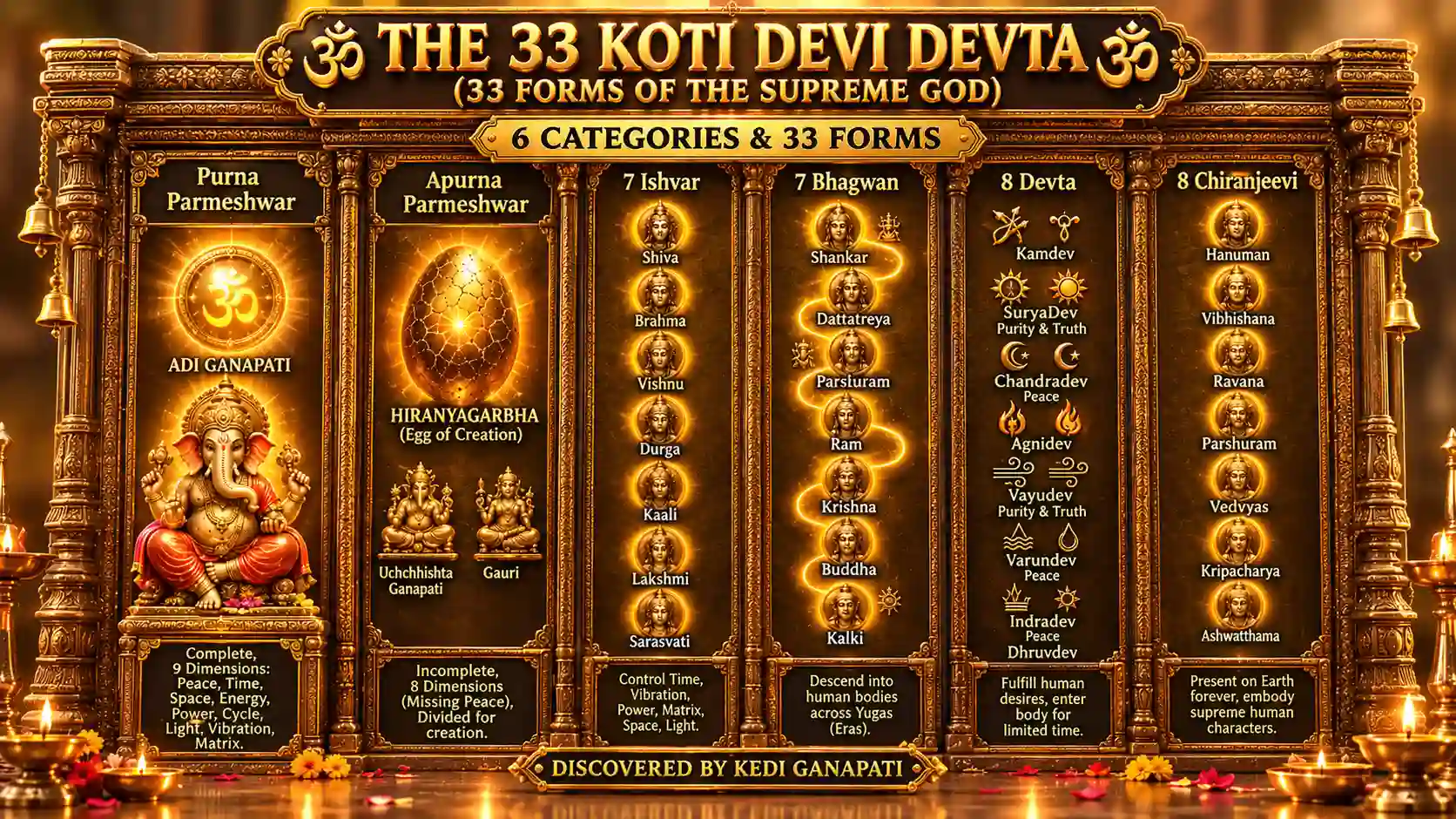
But after experiencing these different temples, their traditions, devotees, and forms of worship, many questions about God started coming into my mind. These questions eventually led me to the wisdom of 33 Koti DeviDevata.
To know how this 5,000 KM pilgrimage and my visits to these temples led me to this wisdom, read My First Pilgrimage: A 5,000 KM Journey Across India.
Read 33 Koti Devi Devata