Introduction to the 33 Koti Devas
Kedi: “On this journey, I had darshan of Lord Vitthal, Goddess Tulja Bhavani, Shivling, Lord Vishnu, and Lord Ganapati—five gods in total. How many gods are there altogether?”
Ganesh: “The Supreme God has 33 forms, which are called the 33 Koti Devas.”
Kedi: “Does 33 Koti mean 33 crore gods?”
Ganesh: “No, 33 Koti means 33 types. Just as categories are referred to as higher koti or lower koti for classification, similarly, the forms of the Supreme God are referred to as 33 Koti instead of 33 types.”
Kedi: “Are the types of God also classified?”
Ganesh: “Yes, the Supreme God desired to perform various actions, so He divided Himself into 6 categories and 33 types.”
Kedi: “What are the 6 categories and 33 types of the Supreme God?”
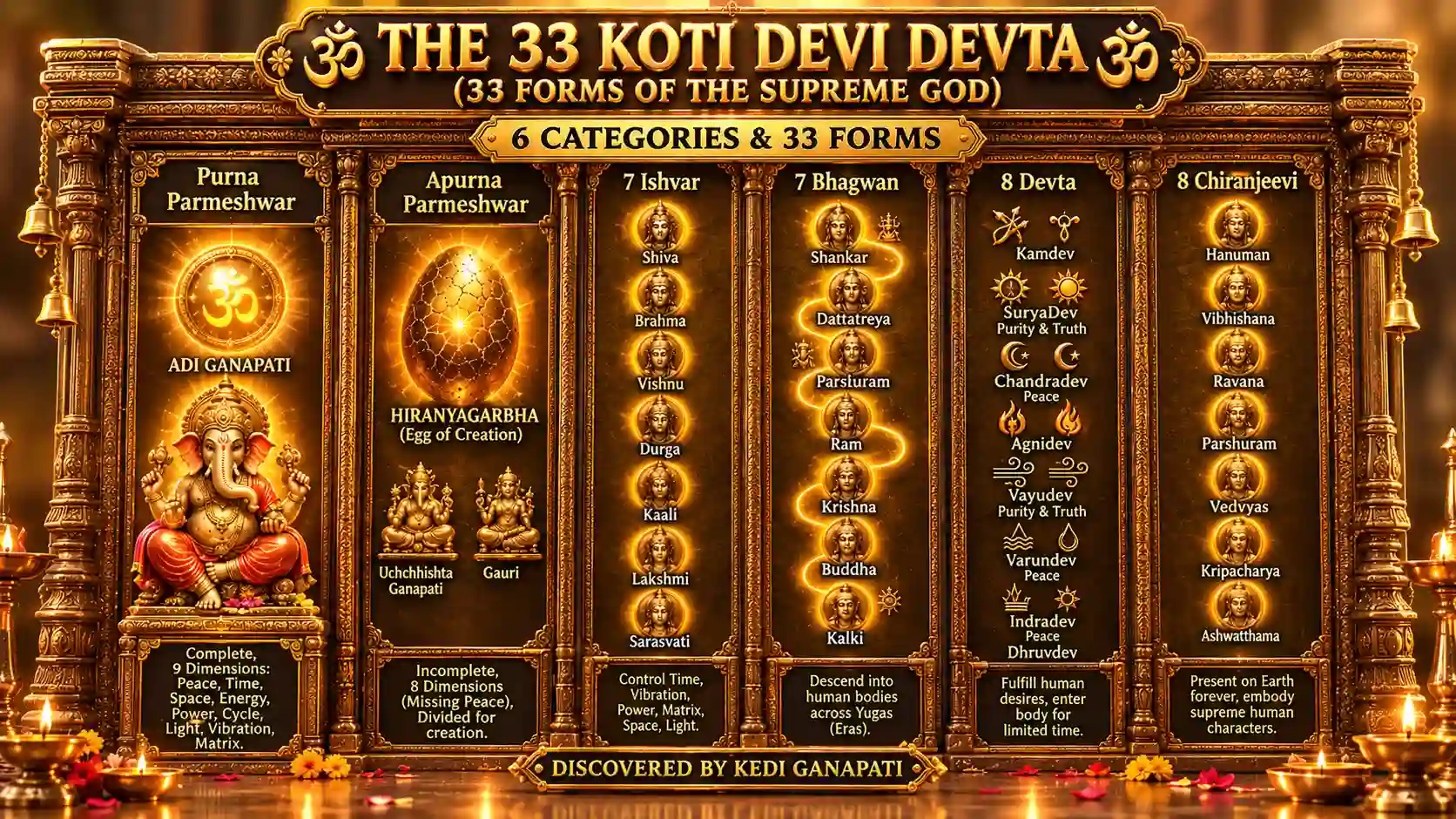
Ganesh: “1 Purna Parmeshwar (Complete Supreme God), 2 Apurna Parmeshwar (Incomplete Supreme God), 7 Ishvar, 7 Bhagwan, 8 Devta, and 8 Chiranjeevi—these are the 6 categories and 33 types of the Supreme God.”
The Origin of Purna and Apurna Parmeshwar
Kedi: “What is the difference between Purna Parmeshwar and Apurna Parmeshwar?”
Ganesh: “Initially, the Supreme God was in a complete form. Every element of the Supreme God was made up of a total of 9 dimensions: peace, time, space, energy, power, cycle, light, vibration, and matrix. No change can occur in a complete form.
The Supreme God wanted to experience various things by bringing change within Himself while also remaining in His original form. Therefore, the Supreme God destroyed the dimension of peace from His center, and at that very moment, the Supreme God divided into two parts: one Complete Supreme God made of 9 dimensions—peace, time, space, energy, power, cycle, light, vibration, and matrix—and one Incomplete Supreme God made of 8 dimensions—time, space, energy, power, cycle, light, vibration, and matrix.
The Complete Supreme God is called Adi Ganapati, and the Incomplete Supreme God is called Uchchishta Ganapati.”
Kedi: “I heard ding-doing, ding-doing; I didn’t understand anything.”
(Sitting on the beach, I felt an intense craving for bhel.)
Ganesh: I will tell you the story of the 33 Koti Goddess-Deities. Then perhaps you will understand.
Kedi: Yes, tell me the story.
Ganesh: In the beginning, Parmeshwar Ganapati was alone, spread everywhere. He was spread so far that he could not see his own boundary. He was alone and resting. Everything everywhere was perfect. There was nothing lacking in anything. Yet there was one thing Parmeshwar could not find — incompleteness.
When Parmeshwar started looking for incompleteness, he realized that he was already complete with all 9 dimensions, and there cannot be incompleteness inside a complete object.
Kedi: Why did Parmeshwar want incompleteness?
Ganesh: Whatever someone does not have, they search for that first. This is the rule of existence.
Kedi: What does being complete with 9 dimensions mean?
Ganesh: Whatever thing is made from the properties of different subjects, those are called dimensions. Parmeshwar is also made from 9 different dimensions.
Kedi: Which dimensions?
Ganesh: Parmeshwar is made from 9 dimensions — peace, time, space, energy, power, cycle, light, vibration, and matrix.
Kedi: What happened next?
Ganesh: Because of the peace dimension, Parmeshwar used to lie peacefully in one place without moving, and even if he wanted to, he could not create any movement. He knew that movement cannot exist in a perfect object. To create movement, he would have to become incomplete. But he did not want to become completely incomplete. He also wanted to remain in his original form.
So he used a method and destroyed the peace dimension from a part of his center. He divided into 2 parts — Purna Parmeshwar and Apurna Parmeshwar.
All 9 dimensions were present within Purna Parmeshwar, so he became Navvinayak. In Apurna Parmeshwar, because the peace dimension was destroyed, only 8 dimensions remained, so he became Ashtavinayak.
Kedi: What happened next?
Ganesh: Movement started in Ashtavinayak Ganapati. He was able to move. Because one peace dimension had come out of his original form, he had become leftover, so he was named Uchchhishta Ganapati.
Purna Parmeshwar developed a desire to see someone other than himself. To fulfill this desire, he developed the desire to create creation.
But then a problem occurred. A single male element could not create creation. For the creation of creation, the female element was necessary.
Purna Parmeshwar could not move by himself, and Apurna Parmeshwar could move, but he was a male element. He also could not create creation alone.
Then Parmeshwar realized that if he could become incomplete from being complete, then he could also become female from being male.
If Purna Parmeshwar made Uchchhishta Ganapati into the female element, then the male element would disappear. Therefore, Purna Parmeshwar gave the female element present within the infinite qualities of Uchchhishta Ganapati an independent form and divided Uchchhishta Ganapati into 2 aspects — one male Parmeshwar and one female Parmeshwari.
Because the female Parmeshwari was the female part of Ganapati himself, the form of the female Parmeshwari was also similar to Ganapati — an elephant head and a human female body.
Kedi: I have seen an idol of a Goddess whose head is that of Ganapati and whose body is female. Is she the same Parmeshwari?
Ganesh: Yes, she is the same Parmeshwari, and her name is Gauri. Because Gauri herself is the female part of Ganapati, Gauri is called Ganapati’s wife.
And with the union of Gauri and Ganapati, the creation of the entire creation began.
First, Gauri Ganapati created an 8-dimensional covering inside Hiranyagarbha and started the work of creating creation.
The Role of Ishwars in Dimension Control
But then a new problem arose. The dimensions inside Hiranyagarbha appeared completely unbalanced, and for the creation of creation, it was very important for the dimensions to be balanced.
Then a desire arose in the mind of Purna Parmeshwar. If he controlled all 8 dimensions together, then perhaps he would not be able to enjoy the depth of all those dimensions at the same time.
But if he created independent forms to control each dimension, then through those independent forms he would be able to deeply balance each individual dimension and also enjoy it.
Kedi: Which independent form did Parmeshwar take?
Ganesh: To control the time dimension, Purna Parmeshwar first took the form of Ishwar Shiva from a part of Uchchhishta Ganapati. A form that only controls dimensions is called Ishwar, so Parmeshwar’s Shiva form was called Ishwar.
But the dimensions also refused to be controlled by the male element alone. Therefore, to control the dimensions, Purna Parmeshwar took the form of Ishwar Kali from a part of Parmeshwari Gauri. Then Ishwar Shiva and Ishwar Kali together began controlling the time dimension.
Kedi: Why did Parmeshwar not create Shiva and Kali from his own part? Why did he create them from the parts of Uchchhishta and Gauri?
Ganesh: Purna Parmeshwar is 9-dimensional. He cannot move because he is complete within himself. Therefore, Ishwar had to be created from the parts of Uchchhishta and Gauri.
And because the male element and female element already existed, Shiva was created from the male Parmeshwar element and Kali from the female Parmeshwari element.
Kedi: What happened next?
Ganesh: Parmeshwar took the forms of Ishwar Brahma and Ishwar Saraswati to control the space dimension. He took the forms of Ishwar Vishnu and Ishwar Lakshmi to control the energy dimension.
Then Parmeshwar realized that by taking the Brahma and Vishnu forms, he could control 2 dimensions, but Ishwar Shiva could control 4 dimensions.
Knowing this, he did not take a fourth male Ishwar form. Instead, he gave Ishwar Shiva the responsibility of the power dimension and, along with it, took the form of Durga for the female Ishwar form.
Then the responsibility of controlling the cycle dimension was given to Ishwar Vishnu and Ishwar Lakshmi.
The responsibility of controlling the light dimension was given to Ishwar Brahma and Saraswati.
The responsibility of controlling the vibration dimension was given to Shiva and Kali.
The responsibility of controlling the Maya dimension was given to Ishwar Shiva and Durga.
In this way, the 8 dimensions were divided among 7 Ishwars.
Kedi: Does this mean that no Ishwar can control another Ishwar’s dimension?
Ganesh: Parmeshwar took the Ishwar forms so that he could deeply experience specific dimensions. Therefore, they cannot even think about controlling other dimensions.
And no matter which Ishwar controls which dimension, all Ishwars are fundamentally forms of one Purna Parmeshwar.
Kedi: How many forms have been taken so far?
Ganesh: Purna Parmeshwar — 1, Adi Ganapati.
Apurna Parmeshwar — 2 forms, Uchchhishta Ganapati and Gauri.
And the 7 forms of Ishwar — Shiva, Brahma, Vishnu, Durga, Kali, Lakshmi, and Saraswati.
Creation of Worlds, Humans, and Bhagwans
Kedi: What happened next?
Ganesh: Parmeshwar created creation from all those dimensions. He created Vaikuntha at the center of Hiranyagarbha, created 7 Devalokas within Vaikuntha, and created countless Hiranyaloks around the Devalokas. He created 7 universes revolving around Vaikuntha, and within each universe he created one Grahalok. The Earth Grahalok where you are right now is also one of them.
Kedi: I don’t understand anything about Vaikuntha, Hiranyalok, or Grahalok.
Ganesh: During a journey, you see many things. You don’t sit down and get stuck on every single subject. For now, just understand the 33 Koti Goddess-Deities. When the time comes, I will explain Vaikuntha to you too.
Kedi: What happened next?
Ganesh: Parmeshwar extracted the Ahankar element from his own part and created Gan, Jiva, and human elements from it so that they could perform karma on different Grahaloks and experience different subjects.
While creating the human element, a problem arose. Because the Ahankar part of Parmeshwar was removed from the human element, humans could become ignorant and egoistic and could forget their existence and the purpose of their life.
After creating humans, Parmeshwar decided to manifest himself in the form of Bhagwan to give humans knowledge of their existence and the purpose of their life.
But a very big problem arose.
Until now, all the forms he had taken were formless and omnipresent. But the form of Bhagwan could not be formless and omnipresent. Its form had to be subtle and physical enough to enter inside a human body.
The size of the human body was different across all 7 Grahaloks and Hiranyaloks. Therefore, it was not possible for a Bhagwan of one fixed size to enter the bodies of humans of all 8 different sizes.
So Parmeshwar made the form of Bhagwan dynamic, so that it could enter human bodies of both small and large sizes, and could also enter his own विशाल body.
Kedi: Can Bhagwan increase and decrease his size?
Ganesh: Among the 33 types of Parmeshwar, only the 7 types of Bhagwan can increase and decrease their size.
Bhag means human body, and van means one who takes or holds. Therefore, the form of Parmeshwar that enters a human body is called Bhagwan.
Kedi: Which 7 Bhagwans?
Ganesh: Shankar, Dattatreya, Parshuram, Ram, Krishna, Buddha, and Kalki are the 7 Bhagwans.
But Ganesh is the 8th Bhagwan, who resides inside the body of Kalki. There are 2 Bhagwans in the same body of Kalki — Kalki and Ganesh.
Kedi: Why did Parmeshwar create 7 Bhagwans? Why not just one?
Ganesh: Humans live on 7 Grahaloks. When there is a need to go to all 7 Grahaloks at the same time, a single Bhagwan cannot go everywhere. Therefore, in such a situation, 7 Bhagwans can incarnate simultaneously on the 7 Grahaloks. That is why Parmeshwar took 7 Bhagwan forms.
Kedi: How can there be 2 Bhagwans inside Kalki’s body? Why isn’t Bhagwan Ganesh simply a separate 8th Bhagwan?
Ganesh: When Parmeshwar created the 7 Bhagwans, a desire arose in his mind: What would happen if there were 2 Bhagwans in one body?
To experience this, he took the 8th Bhagwan form, Bhagwan Ganesh, and combined it inside the body of Kalki.
Kedi: Are Parmeshwar Ganapati and Bhagwan Ganesh different from each other?
Ganesh: Yes. The one who is omnipresent and stationary is Purna Parmeshwar.
The one who is incomplete and moving together with Gauri is Uchchhishta Ganapati. And the one who enters a human body together with Bhagwan Kalki is Bhagwan Ganesh. Thus, Ganesh has 3 forms.
Satans, Deities, and Chiranjeevis
Kedi: What happened next?
Ganesh: A new problem arose. All 7 Grahaloks were created according to the rules of duality. If Bhagwan had to incarnate on a Grahalok for the salvation of humans, then it also became necessary for Satan to incarnate there for the destruction of humans.
Therefore, Parmeshwar Ganapati now had to take the form of Satan, and Parmeshwar Ganapati created 7 Satans for the 7 Grahaloks.
None of the Satans wanted to leave their place and go to another Grahalok, so every Satan got a fixed Grahalok. Satan Kali got the Earth Grahalok, the Grahalok on which you are currently alive.
Kedi: What happened next?
Ganesh: Parmeshwar had given humans 8 desires. He then developed the desire to enter human bodies for some time and help them fulfill those 8 desires.
To fulfill this desire, Parmeshwar Ganapati manifested himself in the form of 8 Deities.
Kedi: Which 8 desires and which 8 Deities?
Ganesh: To fulfill the desire for lust — Kamdev.
To fulfill the desire for purity — Suryadev.
To fulfill the desire for love — Chandradev.
To fulfill the desire for happiness — Agnidev.
To fulfill the desire for peace — Vayudev.
To fulfill the desire for knowledge — Varundev.
To fulfill the desire for bliss — Indradev.
To fulfill the desire for liberation — Dhruvdev.
Kedi: Humans have millions of desires, then why only 8?
Ganesh: The form of the desire can be different, but there are only 8 desires.
Kedi: What is the difference between happiness and bliss?
Ganesh: Whatever gives comfort to the body is happiness, and whatever gives comfort to the mind is bliss.
For example, the comfort you get while eating biryani yourself is happiness. The comfort you get from watching your loved one, child, or parents happily eating biryani is bliss.
Kedi: What happened next?
Ganesh: Parmeshwar had manifested the eighth Bhagwan, so it was also necessary to manifest the eighth Satan. Parmeshwar manifested the eighth Satan and decided to establish him inside the body of one of the Satans.
But none of the Satans agreed to take another Satan inside their body. And the eighth Satan himself had 2 opposing ideologies, so the eighth Satan demanded to divide himself into 2 parts and refused to enter another Satan’s body. He demanded his own independent body.
Parmeshwar Ganapati divided the eighth Satan into 2 parts and named them Koka and Vikoka. The Satan who had demanded to divide himself into 2 parts was Satan Vikoka.
To follow the rules of duality, Parmeshwar also needed to divide one Bhagwan into 2 parts.
Bhagwan Kalki agreed to be divided into 2 parts and also demanded that both parts remain in the same body. Parmeshwar divided Bhagwan Kalki into 2 parts, resulting in Kalki and Maitreya. Kalki and Maitreya began living in the same body.
As a result, the body of Kalki came to have 3 Bhagwans residing in it — Kalki, Ganesh, and Maitreya.
And Satan Kali came to have 3 Satans residing in 3 separate bodies — Kali, Koka, and Vikoka.
Kedi: What happened next?
Ganesh: Parmeshwar created different characters and natures of humans. Among them, 8 natures were attractive, and Parmeshwar developed the desire to become human himself and continuously experience those 8 special characters, while experiencing what it is like to be an immortal man.
To fulfill that desire, Parmeshwar manifested himself in 8 Chiranjeevi forms.
To keep the character and nature of the Chiranjeevis constant, the Chiranjeevis were given a fixed physical form, so that whenever a Chiranjeevi takes rebirth, his character and nature will remain fixed.
Kedi: Which 8 Chiranjeevis?
Ganesh: Parshuram, Hanuman, Vibhishan, Ravan, Kripacharya, King Bali, Ashwatthama, and Ved Vyas — these are the 8 Chiranjeevis.
Kedi: Do the Chiranjeevis also incarnate on the 7 Grahaloks like the Bhagwans?
Ganesh: No. Chiranjeevis reside on Prithvilok throughout their lives. They neither go to heaven, nor to hell, nor to Vaikuntha. Whenever they are reborn, their nature, character, and desires remain the same.
Kedi: How many forms of Parmeshwar have been completed so far?
Ganesh: So far, all 33 types of forms of Parmeshwar have been completed:
1 Purna Parmeshwar,
2 Apurna Parmeshwars,
7 Ishwars,
7 Bhagwans,
8 Deities,
and 8 Chiranjeevis.
Kedi: But there are 8 Bhagwans, right? Bhagwan Ganesh is also there.
Ganesh: Bhagwan Ganesh is inside the body of Bhagwan Kalki. Both have the same body. Therefore, even though there are 8 Bhagwans, there are only 7 Bhagwan bodies. So the Bhagwans are also counted as 7.
Clarifications on Deities and Dashavatara
Kedi: “Then who are Navdurga and Dashavidya? Why are they not included in the 33 Koti Goddess-Deities?”
Ganesh: “The incomplete Parmeshwari Gauri manifested herself as Riddhi and Siddhi. The 9 forms of Navdurga are all 9 forms of Siddhi. The 10 forms of Dashavidya are all 10 forms of Riddhi. All these Goddesses are counted only as 1 Goddess in the form of Gauri. Therefore, since Parmeshwari Gauri is included in the 33 Koti Goddess-Deities, the additional Riddhi and Siddhi are not counted.”
Kedi: “I heard in a TV serial promo that there are a total of 33 types of deities—specifically the 8 Vasus, 11 Rudras, and 12 Adityas. If that is the case, then what exactly are they?”
Ganesh: “Some TV serials contain 1% truth; others contain 10% truth; and some contain 11% truth. TV serials are broadcast not to impart knowledge, but rather to provide entertainment—or sometimes to mislead viewers. Do not ask me about the content of TV serials.”
Kedi: “In that case, what are these Vasu, Rudra, and Aditya?”
Ganesh: “Ishwar Vishnu is referred to as Vasu and Vasudeva. Ishwar Shiva is referred to as Rudra. Ishwar Brahma is referred to as Aditya and Ravidev. Some foolish artists, in an attempt to arrive at the count of 33, fabricated 33 distinct names from the three primary names of Ishwar—Vishnu, Shiva, and Brahma—and declared them to be the ‘33 Koti’ (types) of deities. Ignorant saints subsequently accepted this notion; consequently, even today, some misguided ascetics and devotees continue to interpret this as the literal existence of 33 Koti deities.”
Kedi: “I have heard about Dashavatara. Why was that not included?”
Ganesh: “Dashavatara is not a form of Parmeshwar. Rather, they are all 12 types of minds that Parmeshwar has created so far.
The mind of aquatic creatures is Matsya Avatar.
The mind of amphibious creatures is Kurma Avatar.
The mind of terrestrial and flying creatures is Varaha Avatar.
The mind of humans is Narada Avatar.
The mind of Bhagwan Shankar is Narasimha Avatar.
The mind of Bhagwan Dattatreya is Vamana Avatar.
The mind of Bhagwan Parshuram is Parshuram Avatar.
The mind of Bhagwan Ram is Ram Avatar.
The mind of Bhagwan Krishna is Krishna Avatar.
The mind of Bhagwan Buddha is Buddha Avatar.
The mind of Kalki and Ganesh is Kalki Avatar and Ganesh Avatar.”
Kedi: “Are the minds of living beings and Bhagwans different?”
Ganesh: “Yes. No living being is born with a fixed-sized mind. The size and type of the mind are different.
The minds of all millions of humans are of the same Narada type, but the size of everyone’s mind is different.
All Bhagwans have both different types and different sizes of minds.
Even though Bhagwan Ram and Bhagwan Kalki are both Bhagwans, their desires, nature, character, and qualities are different.
Bhagwan Ram never performs bad deeds, while Bhagwan Kalki performs bad deeds without hesitation.”
Kedi: “How can Bhagwan perform bad deeds? He is Bhagwan, right?”
Ganesh: “Parmeshwar Ganapati wanted Bhagwans to perform only good deeds, but at the same time, he also wanted Bhagwans to perform bad deeds so that no one could say that Bhagwan cannot do everything.”
Kedi: “You said Dashavatara and then counted 12 Avatars. How did 10 become 12?”
Ganesh: “There are 12 Avatars, but there are 2 categories. In one category, there are Dashavatara, which includes 10 Avatars whose body and mind are independent.
In the second category, there are Mahavatars, which include 2 Avatars—Kalki and Ganesh—and both have the same body.
All Dashavatara incarnate many times in one Kalpa, while Mahavatars incarnate only once.”
Kedi: “If Parmeshwar had to take so many forms because of so many desires, and different problems arose because of them, then didn’t Parmeshwar know this in advance?”
Ganesh: “If you had to spend your entire life lying comfortably in the same position without moving, or spend your entire life facing struggles, taking action, and experiencing new challenges, which one would you choose?”
Kedi: “I would choose the challenges. If I lie down too much, I’ll get back pain.”
Ganesh: “Parmeshwar already knew that challenges would arise. Parmeshwar made Himself incomplete in order to experience those challenges, and from that incomplete part, created His various forms and the creation itself.”
Kedi: “Do I still have anything left to know?”
Ganesh: “You have learned the 33 forms of Parmeshwar, learned about Hiranyagarbha, learned about Dashavatara, and learned about the types of mind.
Now you need to experience the taste of the prasad from Ganpatipule Temple. Quickly eat the boondi ladoo and tell me how it tastes.”
I had bought 2 ladoos as prasad from the temple and kept them in my bag. I took a ladoo out of the bag and, while eating it, forgot that I was still talking to Ganesh.